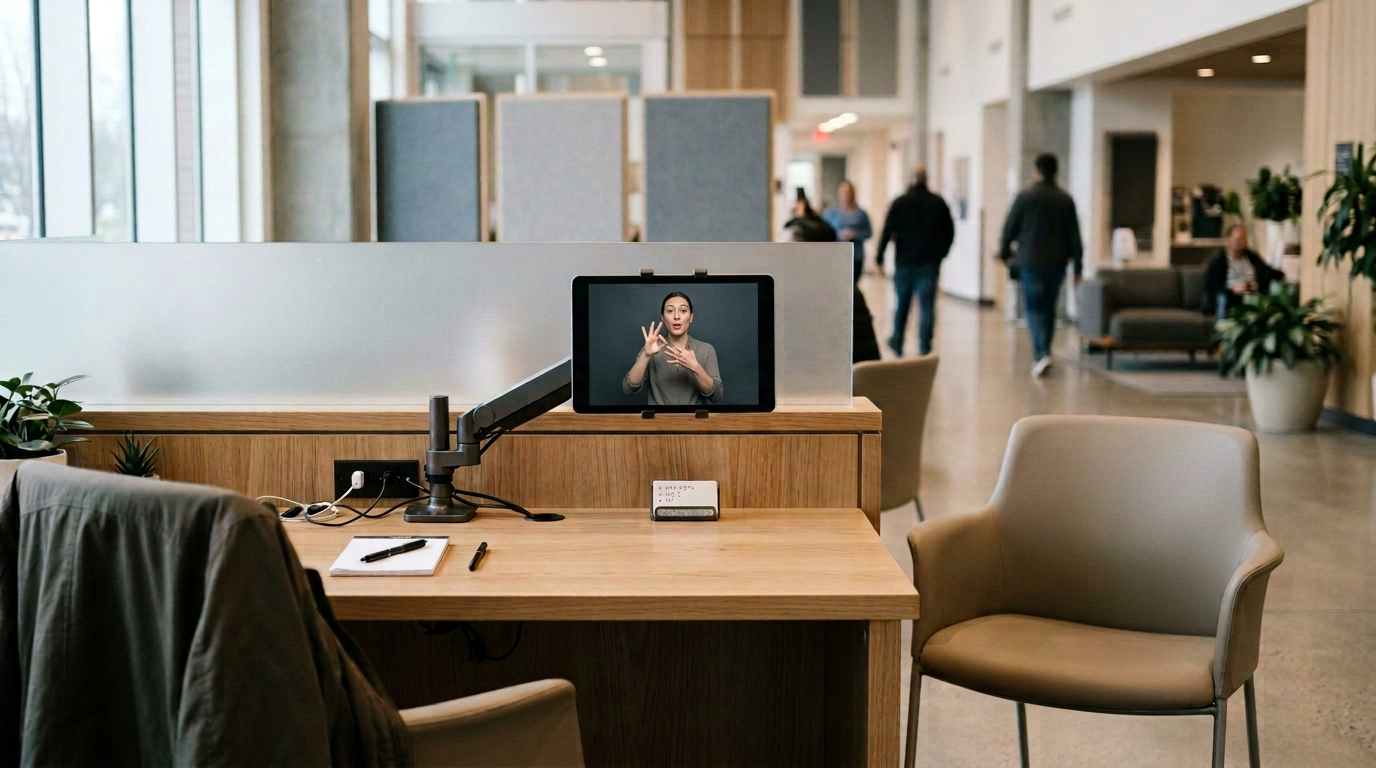
A Deaf or hard-of-hearing client arrives at a provincial service counter, a municipal intake desk, or a Crown corporation customer service point. They need clear communication immediately. No interpreter has been booked.
What happens next is often predictable — and avoidable.
What Typically Happens
In many provincial, municipal, and Crown settings, the response follows a familiar pattern:
- Staff attempt to communicate through written notes or gestures
- The client is asked to wait while someone tries to locate an interpreter
- An appointment is rescheduled for another day
- A family member or companion is asked to interpret informally
- The interaction is cut short or left incomplete
Each of these workarounds creates friction. The client experiences delayed or incomplete access to services. Staff face added pressure and uncertainty. The organization risks complaints, rework, and a gap between its accessibility commitments and actual delivery.
These situations are not rare. Public-facing roles in government and Crown corporations regularly involve unplanned interactions — drop-ins, urgent inquiries, intake processes, and last-minute needs that cannot be scheduled in advance.
Why Scheduled Interpreting Alone Is Not Enough
Scheduled interpreting remains essential for planned meetings, hearings, and appointments. It does not, however, solve the “right now” problem.
When the only available option requires advance booking, accessibility becomes conditional on timing. In high-volume or walk-in environments, that condition is frequently unmet. The result is a structural gap: services are designed to be accessible in theory, yet communication barriers appear the moment an unexpected need arises.
The Practical Fix: On-Demand Access
On-demand video remote interpreting (VRI) directly addresses this gap.
With a platform such as Asign On, staff can connect to a qualified ASL or LSQ interpreter within seconds using a laptop, tablet, or mobile device. There is no scheduling delay, no call centre queue, and no requirement to reschedule the client.
The process is simple:
- Open the platform and request an interpreter
- Match with a professional ASL or LSQ interpreter
- Communicate in real time, face to face
This approach keeps the interaction moving, preserves accuracy, and respects the client’s right to accessible communication in the moment it is needed.
Benefits for Provincial, Municipal & Crown Teams
On-demand VRI supports public-sector realities in several practical ways:
- Faster resolution at counters and service points
- Reduced reliance on informal or incomplete communication methods
- Greater consistency across locations, shifts, and departments
- Better alignment with accessibility standards and human rights expectations
- A flexible complement to existing scheduled and in-person interpreting arrangements
It does not replace planned interpreting services. It fills the critical space between them — the unplanned moments that define much of day-to-day public service delivery.
Moving from Gap to Solution
The question for any provincial, municipal, or Crown organization is straightforward:
When a Deaf client needs an interpreter right now, how quickly can your team provide one?
If the current answer involves waiting, rescheduling, or workarounds, on-demand access offers a clear and immediate improvement.
Real accessibility is measured in the moments that cannot be planned. Closing the “no interpreter available right now” gap is one of the most practical steps public-sector teams can take.
Visit asign.ca to explore how on-demand ASL and LSQ interpreting can support your service delivery, or reach out to discuss a solution tailored to your operational needs.
No pressure — just a practical way to make access available when it matters most.
Leave a Reply