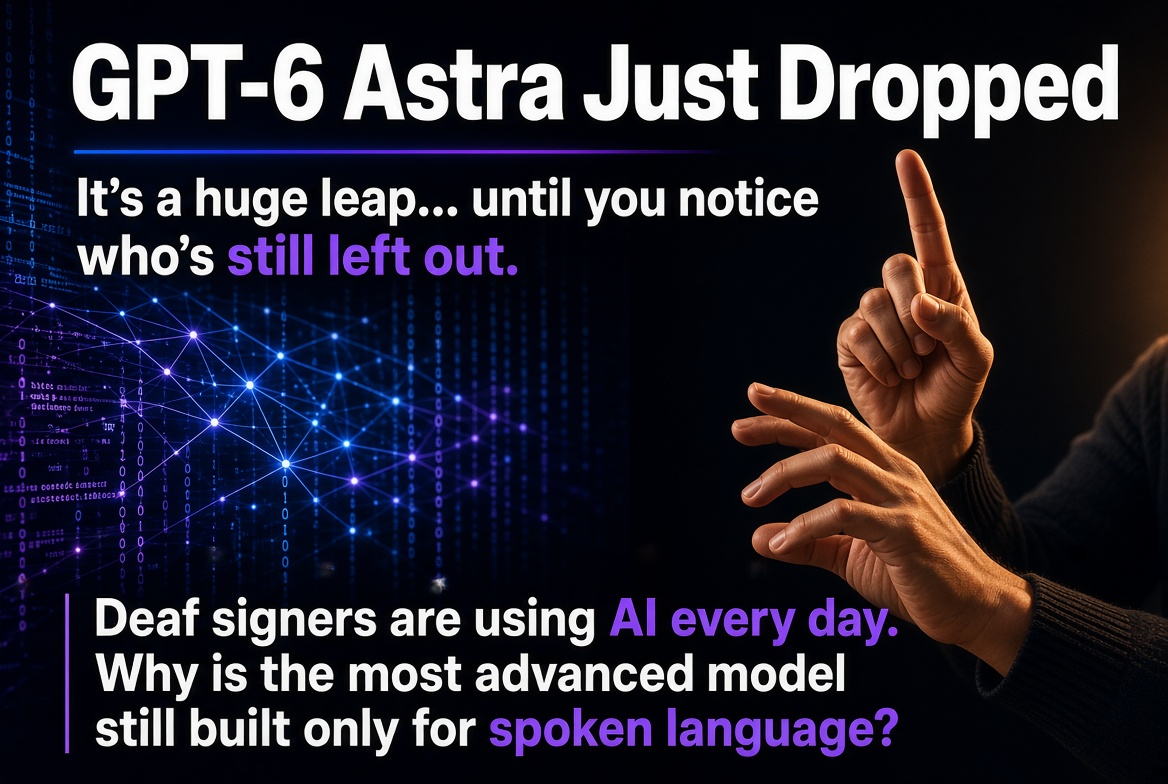
OpenAI just released GPT-6 Astra, and after watching the announcement video, the jump is real. It’s being called a generational leap: stronger computer use, better multi-step professional workflows, higher accuracy with fewer tokens in many cases, and clear gains on hard benchmarks like ARC-AGI-3 and ExploitBench. The model feels more capable at sustained, end-to-end work than what came before it. That part is exciting.
But one limitation stands out immediately. Astra remains built around spoken and written language. Input and output still center on text and speech-adjacent interfaces. For the many Deaf people who use sign languages as their primary language, that creates a real barrier. We already use AI every day for work, learning, communication, and creativity. Leaving sign language out of the core interaction model means we stay on the outside of the most advanced systems.
The technology to close that gap already exists.
Google recently launched SL2T (sign-language-to-text) with the Pixel 11. It translates American Sign Language into written English in real time by analyzing handshapes, facial expressions, and body movement. The feature works inside Gboard and Live Transcribe so signers can search, message, draft, or talk to Gemini without switching to typing. Training data covered more than 100,000 hours across dozens of sign languages, and the system was developed with Deaf community input. It’s not perfect and currently limited to Pixel 11 and ASL-to-English, but it proves the direction is viable.
SignCaption.ai has been building in this space as well. It is available on iOS, Android, and the web, so it works across phones, computers, and other devices. The platform handles automatic captioning of signed video, conversion between signed and spoken content, and related accessibility tools. Because it is web-based and mobile-ready, it already reaches more people without requiring a specific new handset.
These systems show that real-time, usable sign-language interfaces are no longer speculative. They are shipping.
What OpenAI should do next
GPT-6 Astra should incorporate native sign-language support. That means:
- Accepting video or camera input of signing as a first-class modality alongside text and images.
- Producing signed output (via avatar or video) when the user prefers it, not only text or speech.
- Supporting major sign languages with the same seriousness given to spoken languages, starting with ASL and expanding.
- Designing the experience so Deaf users do not have to translate themselves into the hearing world just to use the most capable model.
Accessibility here is not a side feature or a checkbox. Sign languages are complete natural languages. Treating them as optional add-ons after the fact keeps an entire community of AI users one step behind. The people building and using these tools daily—Deaf professionals, students, creators, parents—deserve direct access, not workarounds.
Astra is a genuine milestone in capability and alignment. Making it fully usable by signers would make it a milestone in inclusion as well. The pieces are already on the table. The only question is whether the next version of the most advanced models will finally treat signed languages as equal.
Here’s the video for those who haven’t seen Astra in action yet.