Tag: AI Accessibility

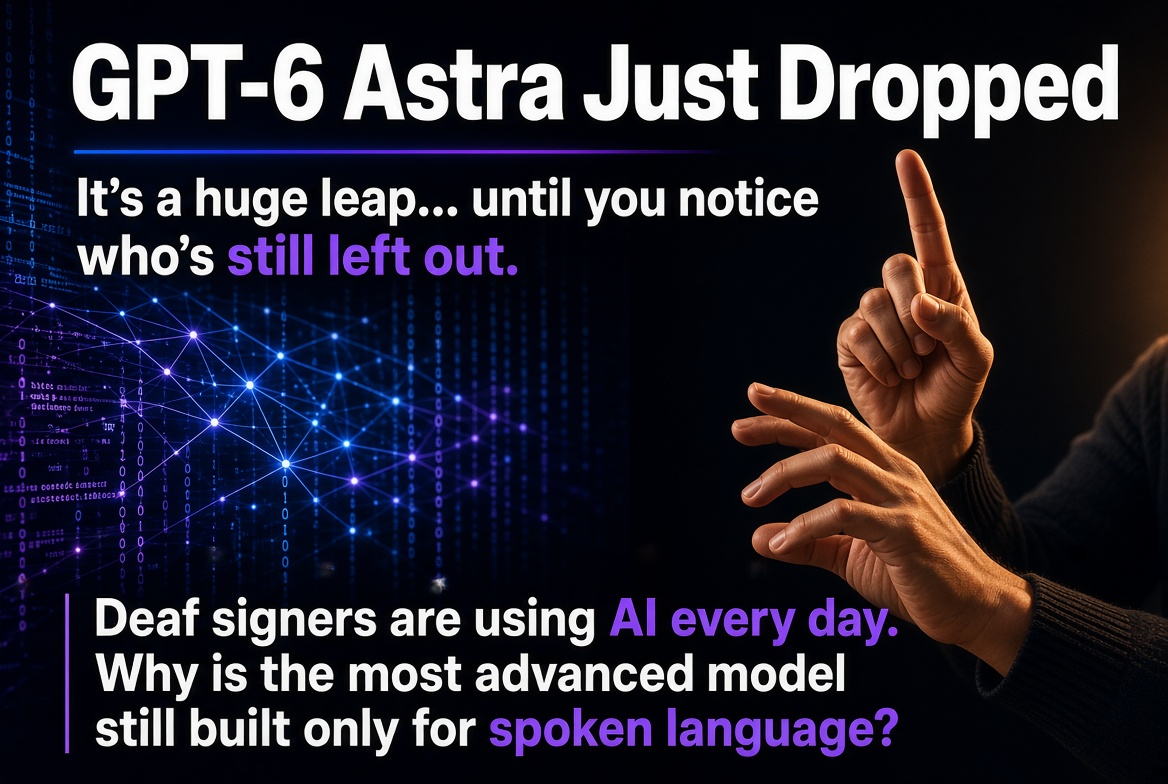
  • GPT-6 Astra is an impressive leap—and it still leaves Deaf signers behind.

    GPT-6 Astra is an impressive leap—and it still leaves Deaf signers behind.

    OpenAI just released GPT-6 Astra, and after watching the announcement video, the jump is real. It’s being called a generational leap: stronger computer use, better multi-step professional workflows, higher accuracy with fewer tokens in many cases, and clear gains on hard benchmarks like ARC-AGI-3 and ExploitBench. The model feels more capable at sustained, end-to-end work than what came before it. That part is exciting.

    But one limitation stands out immediately. Astra remains built around spoken and written language. Input and output still center on text and speech-adjacent interfaces. For the many Deaf people who use sign languages as their primary language, that creates a real barrier. We already use AI every day for work, learning, communication, and creativity. Leaving sign language out of the core interaction model means we stay on the outside of the most advanced systems.

    The technology to close that gap already exists.

    Google recently launched SL2T (sign-language-to-text) with the Pixel 11. It translates American Sign Language into written English in real time by analyzing handshapes, facial expressions, and body movement. The feature works inside Gboard and Live Transcribe so signers can search, message, draft, or talk to Gemini without switching to typing. Training data covered more than 100,000 hours across dozens of sign languages, and the system was developed with Deaf community input. It’s not perfect and currently limited to Pixel 11 and ASL-to-English, but it proves the direction is viable.

    SignCaption.ai has been building in this space as well. It is available on iOS, Android, and the web, so it works across phones, computers, and other devices. The platform handles automatic captioning of signed video, conversion between signed and spoken content, and related accessibility tools. Because it is web-based and mobile-ready, it already reaches more people without requiring a specific new handset.

    These systems show that real-time, usable sign-language interfaces are no longer speculative. They are shipping.

    What OpenAI should do next

    GPT-6 Astra should incorporate native sign-language support. That means:

    • Accepting video or camera input of signing as a first-class modality alongside text and images.
    • Producing signed output (via avatar or video) when the user prefers it, not only text or speech.
    • Supporting major sign languages with the same seriousness given to spoken languages, starting with ASL and expanding.
    • Designing the experience so Deaf users do not have to translate themselves into the hearing world just to use the most capable model.

    Accessibility here is not a side feature or a checkbox. Sign languages are complete natural languages. Treating them as optional add-ons after the fact keeps an entire community of AI users one step behind. The people building and using these tools daily—Deaf professionals, students, creators, parents—deserve direct access, not workarounds.

    Astra is a genuine milestone in capability and alignment. Making it fully usable by signers would make it a milestone in inclusion as well. The pieces are already on the table. The only question is whether the next version of the most advanced models will finally treat signed languages as equal.

    Here’s the video for those who haven’t seen Astra in action yet.

  • Day 15: Deaf Accessibility Wins – Deaf-Led AI for Sign Language Recognition

    In yesterday’s post I talked about voice-to-text tools. Today, let’s look at the other side — sign language recognition technology.

    There are already ASL and BSL recognition tools on the market, but two standout Deaf-led projects are particularly exciting:

    • GoSign.ai — They’ve developed fun learning apps, including matching games where users pair ASL signs with images, plus other interactive games to practice sign language.
    • SignCaption.ai — They recently launched a Transcription Mode that significantly improves AI accuracy when translating ASL to English. Without accurate transcription, AI struggles. This feature speeds up the process and reduces errors.

    What makes these tools special is that they are Deaf-led. Having Deaf people involved from the beginning ensures the technology is built with real lived experience, cultural understanding, and practical needs in mind.

    By embracing AI responsibly, we can shape it ethically and make sure the Deaf community is not left behind — but actively leading the way.

    These projects represent exciting accessibility wins in the intersection of technology and Deaf innovation.


    What about you? Have you tried any sign language recognition apps or AI tools? What features would you love to see in future Deaf-led AI technology?

    Share your thoughts and ideas in the comments!

    See you on Monday for Day 16!

  • ‘Nothing About Us Without Us’: Why AI Accessibility Demands Deaf Leadership


    Author's Note

    This article was originally published on DeafDots on June 5, 2026.

    As the original author, I am republishing it here on my personal blog to make the content accessible to my audience and to continue the conversation around artificial intelligence, accessibility, and Deaf leadership.

    Original publication details:

    Title: "Nothing About Us Without Us: Why AI Accessibility Demands Deaf Leadership"

    Author: Jordan Sangalang, Local Journalism Initiative Reporter

    Originally published by DeafDots on June 5, 2026.

    The article below appears substantially as originally published, with only minor formatting adjustments made for this website.

    By Jordan Sangalang, Local Journalism Initiative Reporter

    As artificial intelligence rapidly embeds itself into Canadian infrastructure—influencing everything from automated workplace tools to emergency alert systems—advocates warn that a major digital divide is forming. Without deliberate intervention, the technology risks leaving behind millions of disabled Canadians.

    Jeffrey Beatty, Chairperson of the Deaf Wireless Canada Consultative Committee (DWCC), is stepping forward to outline the immense opportunities and steep systemic risks AI introduces to the daily lives of Deaf, DeafBlind, and Hard of Hearing (DDBHH) Canadians.

    Speaking strictly from a public accessibility policy perspective, Beatty emphasizes that the rise of AI is fundamentally shifting the landscape of human rights and communication access.

    “For Deaf, DeafBlind, and Hard of Hearing Canadians, this is not just a technology issue,” Beatty states. “It is an accessibility, language, and rights issue.”

    A Tool for Efficiency, Not an Authority

    In his daily policy and advocacy work, Beatty actively leverages AI tools. He uses them to process large quantities of public information concerning telecommunications, regulatory captioning requirements, and digital services.

    “They help me organize information, summarize long documents, improve writing clarity, prepare notes, and compare complex public information,” Beatty explains. He views the technology as a valuable asset for parsing dense, multi-layered regulatory frameworks.

    However, Beatty is quick to draw a hard line between a tool that assists human capability and one that replaces it.

    “I do not treat AI as the final authority. AI can make mistakes, miss context, or give information that sounds confident but is wrong. AI supports the work. It does not replace DDBHH people.”

    For Beatty, the final judgment on any policy piece must remain rooted in human expertise, community accountability, and the lived realities of the DDBHH community.

    The Limitations of Text and Audio-Centric Design

    While text-generation models can streamline administrative tasks or translate complex legalese into plain language, Beatty notes that current mainstream AI design suffers from a deep-seated auditory bias.

    “My biggest concern is that many AI tools are still built around hearing people, speech, audio, and written English,” Beatty says. This structural bias means that users of American Sign Language (ASL), Langue des signes québécoise (LSQ), and Indigenous Sign Languages (ISLs) are frequently excluded or fundamentally misunderstood by modern algorithms.

    True communication access extends far beyond basic English text transcription. Sign languages are distinct, complete languages featuring complex spatial structures and cultural nuances.

    “Many Deaf people use ASL, LSQ, or ISLs which include visual grammar, facial expression, movement, space, and culture. AI tools must respect that,” Beatty says. He notes that poorly trained models regularly generate inaccurate captions, broken translations, or digital avatars that completely fail to replicate real sign language syntax.

    Furthermore, Beatty highlights serious emerging risks regarding data sovereignty, consent, and safety. Because sign languages are inherently visual, training AI translation tools requires vast amounts of video data—raising critical concerns about personal privacy, digital identity ownership, and the targeted misuse of deepfake technology.

    A Vision for Deaf-Led Governance

    To prevent these technologies from further marginalizing communities, Beatty calls for a complete overhaul of how accessibility is handled in tech development. Historically, accessibility features have been treated as an afterthought—tacked onto a product right before release.

    Beatty argues that the DDBHH community must be structurally integrated into the entire lifecycle of AI development, moving from passive consumers to systemic leaders.

    “In the future, I hope DDBHH Canadians are not only users of AI,” Beatty shares. “We should be leaders, testers, researchers, educators, policy advisors, and decision-makers.”

    The ultimate goal is to see AI safely deployed to improve automated captioning accuracy, strengthen localized emergency communications, and lower barriers to public services—but strictly under a framework of cultural respect and Deaf-led governance.

    “My hope is simple,” says Beatty. “AI should not speak for DDBHH people. AI should support DDBHH people, with DDBHH leadership built in from the start.”

    Watch the full video interview below to hear Jeffrey Beatty’s complete perspective on AI policy and accessibility in Canada:

    Play Video Interview.
    Note: Video will pop up when pressing ‘Play’

    Have Your Say

    How is artificial intelligence affecting your daily access to services, employment, or education? Should the Canadian government mandate disabled and Deaf leadership when setting national AI accessibility standards?

    Leave your thoughts and experiences in the comments section below.


    About This Article

    This article was originally reported and written by Jordan Sangalang and first published by DeafDots on June 5, 2026. It is republished here by the author to support ongoing discussions about AI accessibility, Deaf leadership, and inclusive technology policy in Canada.