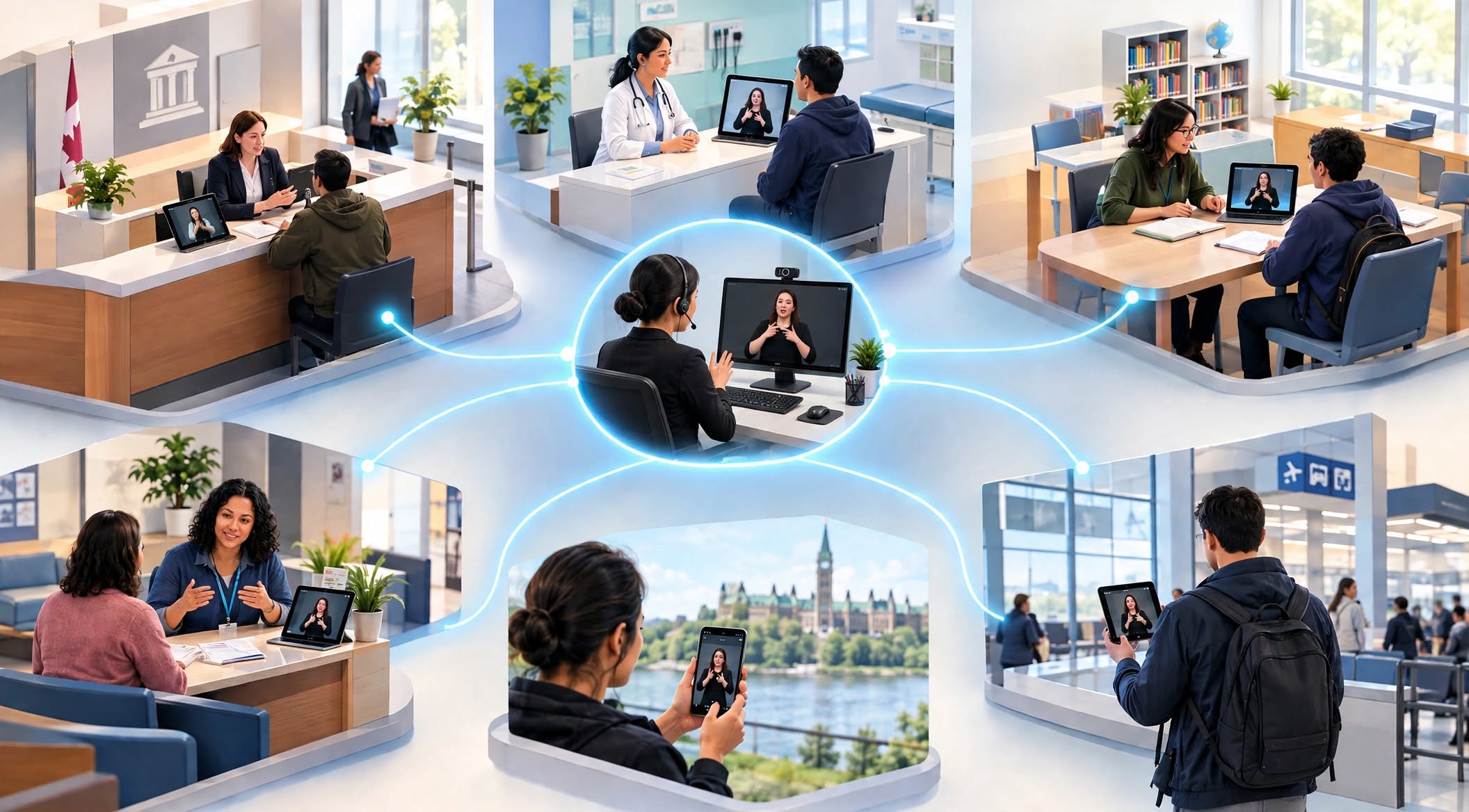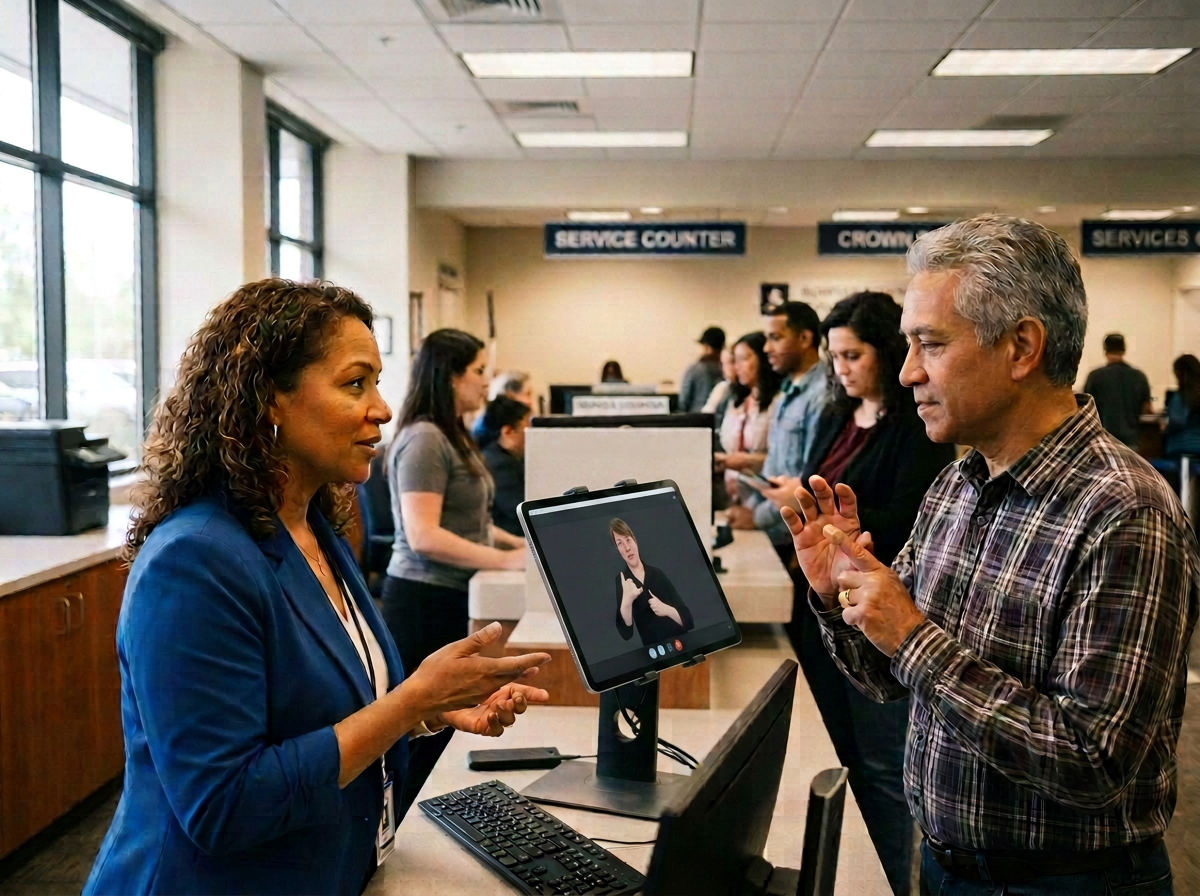
Choosing a video remote interpreting (VRI) solution is a practical decision with lasting operational impact. For provincial, municipal, and Crown accessibility leads, the goal is not simply to add a new tool — it is to close the gap between planned interpreting and the unplanned moments that define much of public service delivery.
Before selecting a platform, these five questions help separate solutions that look good on paper from those that perform reliably in real public-sector environments.
1. How quickly can staff actually connect to an interpreter?
Speed is the core value of on-demand VRI. Ask for clear information on average connection times and what happens during peak periods. A platform that requires multiple steps, long waits, or complex logins undermines the purpose of on-demand access.
The practical test is simple: if a Deaf client is standing at a service counter right now, how long until a qualified ASL or LSQ interpreter is available on screen?
2. Are both ASL and LSQ supported at a professional level?
Canada’s linguistic reality includes both American Sign Language (ASL) and Langue des signes québécoise (LSQ). A solution that treats one language as secondary creates uneven access across regions and client groups.
Confirm that the platform provides reliable, high-quality interpreting in both ASL and LSQ, delivered by qualified professionals.
3. What professional standards and affiliations do the interpreters meet?
Public-sector environments often involve sensitive information, regulated processes, and security requirements. Ask about interpreter qualifications, ongoing professional development, security clearances (including Reliability through Top Secret where relevant), and professional association membership.
In Canada, several key organizations set professional expectations:
- CASLI (Canadian Association of Sign Language Interpreters, formerly AVLIC) is the national professional association and certifying body for ASL-English interpreters. It manages the Canadian Evaluation System (CES) and grants the Certificate of Interpretation (COI). CASLI also maintains a public Interpreter Directory of vetted professionals.
- AQILS (Association québécoise des interprètes en langues des signes) is the professional non-profit association representing sign language interpreters (including LSQ and ASL) in Quebec. Interpreters join AQILS to adhere to professional codes of ethics, maintain certification standards, and access networking and continuous professional development. LSQ interpreters in Quebec are primarily represented and supported by AQILS.
- WAVLI (Westcoast Association of Visual Language Interpreters) is the provincial professional association for ASL-English interpreters in British Columbia. WAVLI supports members and advances sign language interpretation standards through professional development and leadership. It holds legislative occupational title protection in B.C., meaning only members in good standing may use the restricted titles: Registered ASL-English Interpreter, Registered Sign Language Interpreter, and Registered Visual Language Interpreter.
CASLI and AQILS maintain an organizational partnership to support consistent professional standards across the country. Asking whether interpreters are affiliated with these associations (or equivalent recognized provincial bodies such as WAVLI) helps ensure the people who appear on screen meet established ethical and professional expectations.
4. How easily can front-line staff use the platform in real conditions?
The best technology fails if it is difficult to access under pressure. Consider:
- Can staff launch a session from a laptop, tablet, or mobile device with minimal training?
- Is the process consistent across locations and shifts?
- Does it work in typical service-counter or office environments?
A solution that requires specialized equipment or lengthy setup will see limited adoption precisely when it is needed most.
5. Does the provider understand Canadian public-sector realities?
On-demand VRI for government, provincial, municipal, and Crown services is not the same as a generic consumer video tool. Look for experience with Canadian accessibility expectations, bilingual (ASL/LSQ) delivery, and the operational patterns of public-facing teams.
A provider that understands these contexts can support both the technology and the practical rollout across your organization.
Moving from Evaluation to Decision
These questions help accessibility leads move beyond feature lists and focus on operational fit. The right VRI solution should make professional ASL and LSQ interpreting available within seconds, integrate smoothly into existing workflows, and complement — rather than replace — scheduled interpreting services.
When the answers are clear and positive, on-demand access becomes a reliable part of the service model instead of another item on a future wish list.
Visit asign.ca to explore how on-demand ASL and LSQ interpreting can support your provincial, municipal, or Crown operations, or reach out to discuss the questions that matter most for your team.
The right questions lead to the right capability — available when it is needed.