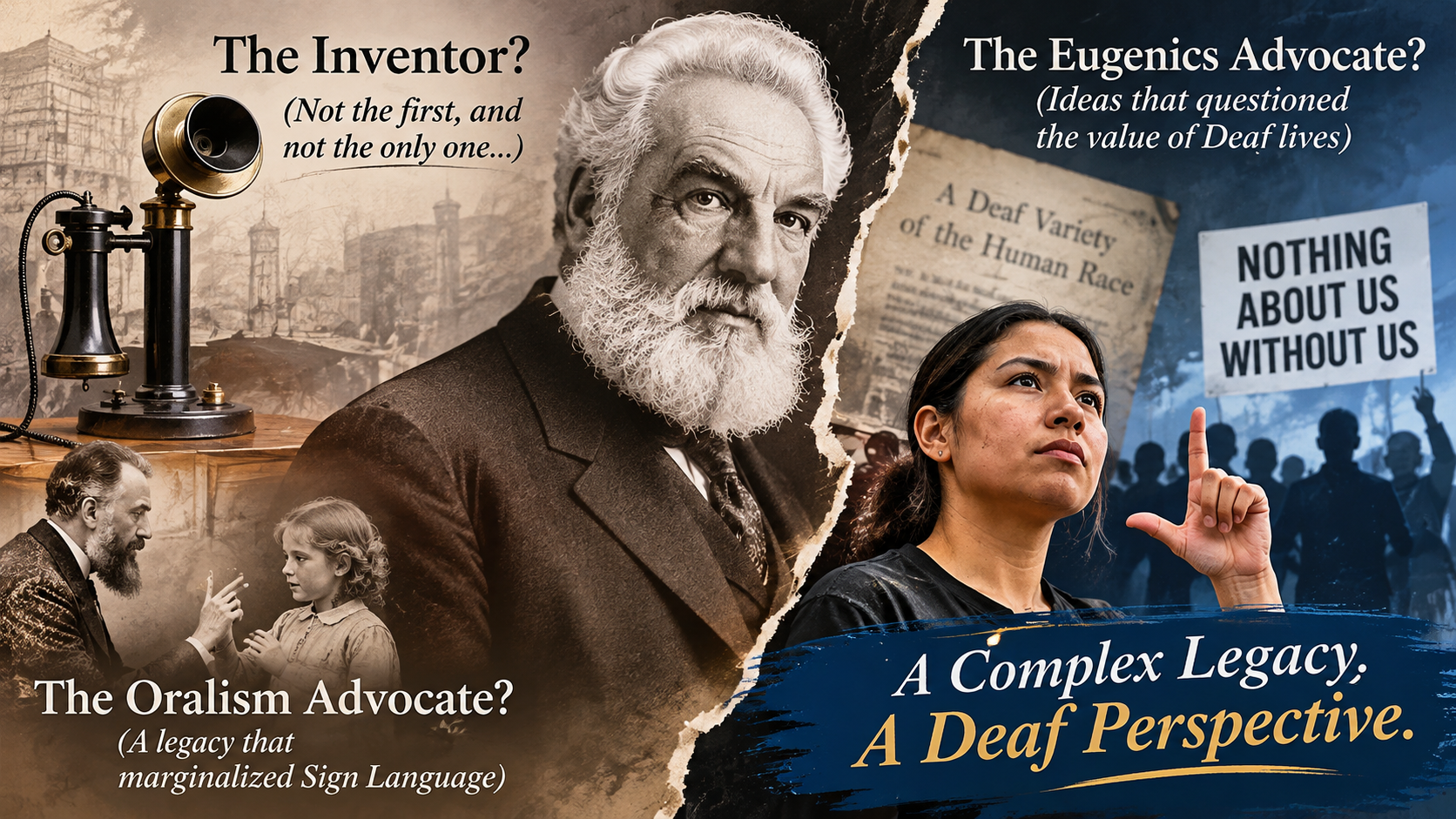
Did you know that Canada recently revisited how Alexander Graham Bell is officially remembered?
If you’re part of the Deaf community or have studied Deaf history, you may already know about Bell’s influence on Deaf education, oralism, sign language and eugenics.
But if you don’t, you may know him primarily as the inventor of the telephone.
And that is exactly why I think this conversation deserves more attention.
Because Alexander Graham Bell’s legacy is not only a story about invention and innovation.
It is also part of Deaf history.
And when Canada decides how Bell should be remembered, I believe the Deaf community should have a meaningful voice in that conversation.
Bell’s legacy looks very different from a Deaf perspective
For much of the general public, Bell represents innovation.
The telephone.
Scientific achievement.
Communication.
Canadian history.
But for many Deaf people, his name carries another meaning.
Bell was one of the most influential advocates of oralism in Deaf education.
He promoted speech-based education and opposed the use of sign language as the primary language of instruction for Deaf children. He also opposed Deaf people becoming teachers of Deaf children, believing they could not effectively teach speech and articulation.
His influence contributed to an educational system that increasingly prioritized speech and lipreading while pushing sign language and Deaf educators to the margins.
The consequences of that history lasted for generations.
This wasn’t simply a disagreement over teaching methods.
It was about language, identity, education, culture and power.
It was about who had the authority to decide what Deaf children needed.
And most importantly, Deaf people themselves were often not the ones making those decisions.
The Dictionary of Canadian Biography documents how oral education expanded significantly while concerns from Deaf representatives who opposed exclusive oralism went unheard.
From a Deaf community perspective, that history cannot simply be separated from Bell’s celebrated accomplishments.
But even the telephone story is more complicated than we were taught
There is another reason I think we should be willing to look more closely at Bell’s legacy.
Many of us grew up with a very simple version of the story:
Alexander Graham Bell invented the telephone.
But the history of the telephone was much more complicated than that.
Bell was certainly a major figure in its development. He obtained the famous U.S. Patent No. 174,465 in 1876 and went on to develop and commercialize a working telephone system. The Library of Congress notes that Bell is conventionally credited as the inventor because of his patent and successful development of a working device.
However, Bell was not the first person to experiment with transmitting speech electrically.
Italian inventor Antonio Meucci developed an early voice-communication device in the 1850s and filed a patent caveat in 1871. Due to financial difficulties, Meucci was unable to renew that caveat after 1874. Bell later obtained the telephone patent in 1876.
The U.S. House of Representatives subsequently passed a resolution in 2002 recognizing Meucci’s life, achievements and contribution to the invention of the telephone.
There were also other important contributors, including Johann Philipp Reis and Elisha Gray. The Library of Congress describes the history as a contentious invention story involving several people working toward similar breakthroughs.
So even the familiar story of Bell as the singular inventor is more complicated than the version many of us learned.
And I think that matters because it illustrates a broader point:
Historical narratives often become much simpler than the history itself.
A complicated story becomes a single name.
A collection of contributors becomes one celebrated individual.
And the experiences of people affected by that person’s work can disappear from the story altogether.
That is exactly what I don’t want to happen with Deaf history.
Then there is the eugenics connection
This is the part that I think deserves considerably more public awareness.
In 1884, Bell published Upon the Formation of a Deaf Variety of the Human Race.
He expressed concern about Deaf people forming communities, socializing with one another and marrying other Deaf people.
He feared that this could lead to what he described as a “deaf race.”
Gallaudet University’s National Deaf Life Museum documents this history and explains how Bell’s ideas became influential within the oralist movement and intersected with eugenic thinking.
Bell’s ideas about heredity and Deafness were not merely theoretical.
They contributed to a broader social environment in which Deaf people were increasingly viewed through the lens of preventing or reducing Deafness.
That should matter to us today.
Because when society begins asking whether Deaf people should exist, whether Deaf children should be born, or whether Deafness should be prevented, we are no longer simply talking about history.
We are talking about the value society places on Deaf lives.
But history needs nuance
As a Deaf advocate, I don’t think we strengthen this conversation by reducing Bell to a cartoon villain.
The historical record is more complicated than that.
Parks Canada’s revised designation acknowledges that Bell held eugenics-related beliefs and argued against intermarriage among congenitally Deaf people. But it also acknowledges that he opposed segregation, institutionalization, sterilization and legislative bans on intermarriage, and eventually abandoned formal involvement in eugenics organizations.
Academic historians have similarly emphasized the complexity of Bell’s relationship with eugenics. Brian Greenwald and John Vickrey Van Cleve, for example, describe Bell as becoming entangled in the eugenic environment of his time while also attempting to prevent eugenicists from interfering with Deaf people’s reproductive rights.
That distinction is important.
We should not claim that Bell supported every coercive eugenic policy.
But we also shouldn’t use those distinctions to erase his documented beliefs and influence.
Both parts of the history deserve to be told.
So why is this important now?
Because Canada has actually done something significant.
In 2025, the Historic Sites and Monuments Board of Canada reviewed Bell’s designation as a National Historic Person.
Parks Canada subsequently revised the official reasons for his designation to acknowledge his oralist advocacy, discouragement of sign language and eugenics-related beliefs.
That is not just a historical footnote.
It is a change in how Canada officially remembers one of its most famous historical figures.
And yet, I have to ask:
How many Canadians know about it?
And perhaps even more importantly:
How many Deaf Canadians know about it?
I’m not asking because I believe nobody in the Deaf community knows.
Deaf historians, scholars, educators and community members have been discussing Bell’s legacy for decades.
The issue is whether this particular development has reached the broader Deaf community and whether Deaf people have been meaningfully included in the process of determining how this history is represented.
Those are two different things.
Who gets to tell Deaf history?
This is where I believe we need to go beyond simply asking whether Parks Canada got the history right.
We should also ask:
Who was involved in telling it?
Parks Canada states that its designation review process can involve subject-matter experts, implicated communities, stakeholders and local communities.
That’s important.
But as a Deaf advocate, I want to know more.
Were Deaf organizations consulted?
Were Deaf historians and Deaf Studies scholars involved?
Were Deaf community members given opportunities to contribute?
What perspectives did they provide?
How did those perspectives influence the final decision?
And perhaps most importantly:
How was the outcome communicated back to the Deaf community?
Because there is a difference between having a consultation process and having meaningful Deaf participation.
There is a difference between talking about Deaf people and creating space for Deaf people to shape the story.
And there is a difference between making historical information technically accessible and making sure it actually reaches the community whose history is being discussed.
This is about more than Alexander Graham Bell
Bell is one person.
But the larger issue is much bigger.
For generations, Deaf people were told that speech was better than sign language.
Deaf children were placed in educational systems designed around hearing norms.
Deaf teachers were pushed aside.
Sign languages were discouraged or prohibited.
And decisions about Deaf people’s lives were frequently made without Deaf people having meaningful authority.
This is part of our history.
It is also part of the reason Deaf communities today continue to advocate for:
Deaf-led education.
Deaf leadership.
Sign language rights.
Deaf representation.
Nothing about us without us.
These aren’t simply modern slogans.
They are responses to a very long history of decisions being made about Deaf people without Deaf people.
And this is where Bell’s legacy becomes relevant today
We might be tempted to say:
“That was over a hundred years ago.”
But some of the questions Bell’s legacy raises are still with us.
Who decides what communication method a Deaf child should use?
Who decides what constitutes a successful Deaf education?
Who decides whether sign language is essential?
Who decides whether Deaf people should be represented in decisions affecting Deaf children?
And increasingly:
Who gets to decide whether Deafness itself should exist?
Today, we are having conversations about genetic testing, gene editing and technologies that could potentially prevent or alter Deafness.
Those conversations are not identical to the eugenics debates of Bell’s era.
But the historical connection is important.
Whenever society discusses eliminating a characteristic from future generations, we need to ask:
What are we saying about the people who already live with that characteristic?
For Deaf people, Deafness isn’t simply a genetic condition to be corrected.
It can be language.
It can be culture.
It can be community.
It can be identity.
It can be connection.
It can be a way of experiencing the world.
That perspective needs to be present in conversations about our future.
Bell married a Deaf woman. Does that change the story?
This is one argument that has emerged from Bell’s descendants.
Bell’s wife, Mabel Hubbard Bell, was Deaf. Bell communicated with her and supported her in many ways.
His descendants have also pointed to his statements supporting an individual’s freedom to marry whom they chose.
Those facts are real and should not be ignored.
But they don’t erase the larger historical record.
A person can love and respect individual Deaf people while holding ideas that negatively affect Deaf people as a group.
A person can have a Deaf spouse while advocating educational practices that marginalize Deaf language and Deaf teachers.
A person can oppose government-enforced marriage restrictions while still warning Deaf people about marrying other Deaf people.
Human beings are capable of holding contradictory beliefs.
History doesn’t become clearer when we remove those contradictions.
It becomes clearer when we examine them.
What should Canada do with Bell’s legacy?
I don’t believe the answer is to erase him.
I don’t believe the answer is to remove every reference to him.
And I don’t believe we should pretend his scientific and technological contributions didn’t happen.
Instead, I believe Canada should tell the whole story.
If visitors learn about Bell’s contributions to communication, they should also be able to learn about his influence on Deaf education.
If his work in science is celebrated, his writings about hereditary Deafness should not be hidden.
If his historic site tells his story, Deaf people’s experiences should be part of that interpretation.
And if Canada is going to reconsider his historical designation, Deaf perspectives should be visible in that process.
Not as an afterthought.
Not as a footnote.
Not simply as another stakeholder.
As people whose history is directly connected to the story being told.
We need more Deaf voices in the conversation
This is perhaps the biggest reason I’m writing about this.
Not because I think everyone needs to agree on Alexander Graham Bell.
Not because I want to tell people what conclusion they should reach.
And not because I think history should be rewritten to make us comfortable.
I’m writing because Deaf history needs to be part of public history.
For too long, Deaf history has existed in spaces that many people outside the Deaf community never encounter.
Our stories are taught in Deaf schools, Deaf Studies programs, museums, archives, community organizations and within Deaf communities.
But when national institutions tell Canadian history, those stories need to be there too.
And when they are there, Deaf people need to be involved in telling them.
That’s what Deaf leadership and representation should look like.
So, did you know about this?
If you already knew, I would love for you to continue the conversation.
If you didn’t, I hope this gives you a reason to learn more.
Read the historical research.
Look at Bell’s own writings.
Read the Parks Canada designation.
Learn about the history of oralism.
Learn about the Deaf people who challenged it.
And, most importantly, listen to Deaf historians, Deaf scholars and Deaf community members who have been carrying this history for generations.
Because this isn’t simply the story of Alexander Graham Bell.
It’s part of our story.
And when Canada decides how that story is remembered, Deaf people deserve a seat at the table.
Not because we want to erase history.
Not because we want to rewrite history.
But because nothing about us should be remembered without us.