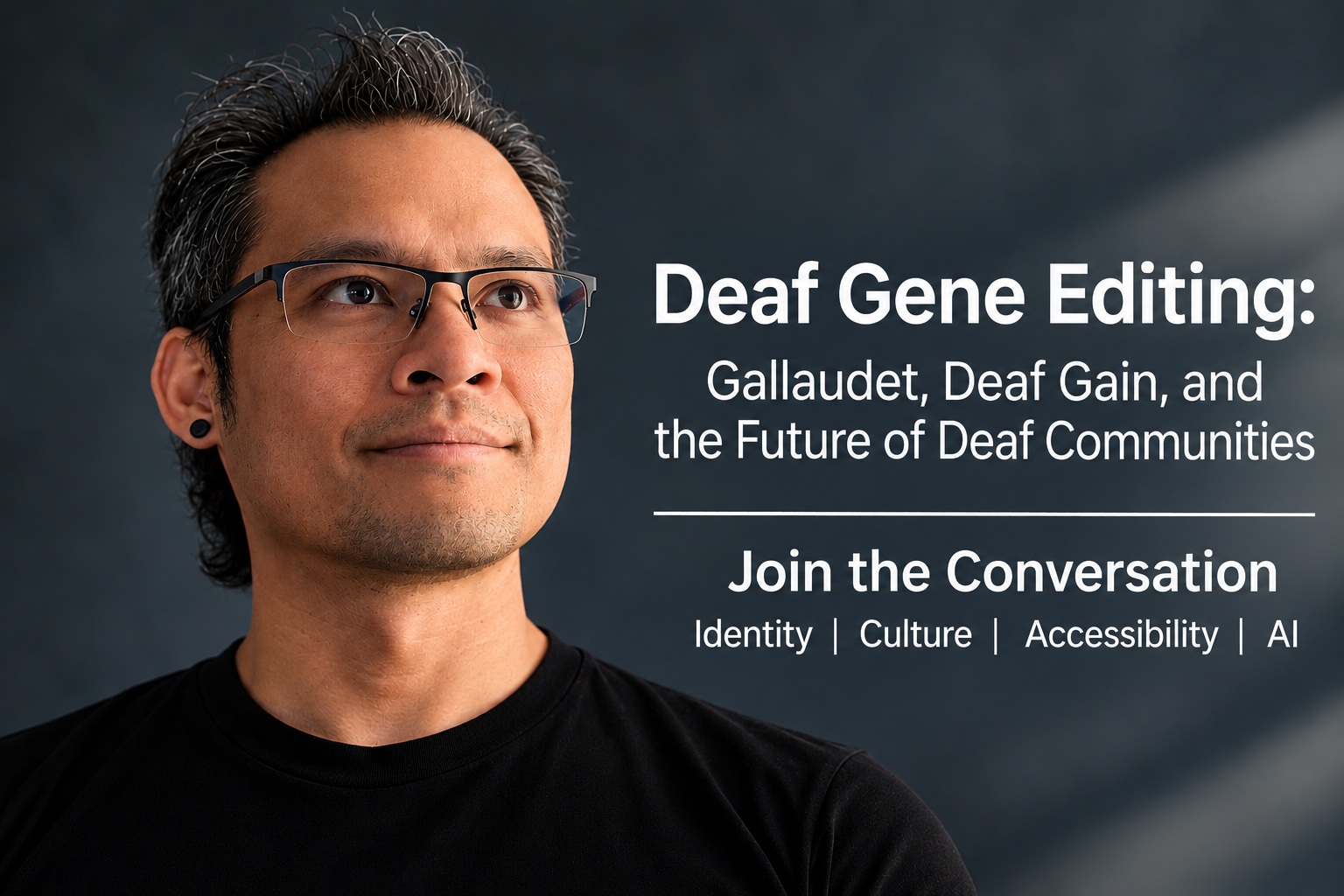
Over the past couple of weeks, I’ve had several experiences that have given me a lot to reflect on as a Deaf person.
I shared updates about my progress in signing the Canadian national anthem in ASL and LSQ because, for me, it was more than simply performing a song. It was an opportunity to represent the Canadian Deaf community and show what Deaf representation can look like on a national stage.
Then I had the opportunity to sit on a panel as one of the contributors to the Disability Ways book launch, where we talked about disability gain and Deaf Gain and what it means to recognize the contributions that come from disability and Deaf experiences.
And now, another conversation has emerged that brings many of these ideas together.
On November 10, 2026, Gallaudet University announced its position on gene editing, gene therapy, and human diversity. As a Deaf person myself and a former graduate of Gallaudet University, this immediately caught my attention.
I want to share what is happening, why Gallaudet has taken this position, and some of the concerns being raised within Deaf communities.
But more importantly, I want this to become a conversation.
What does it mean when science develops the ability to change something that some people consider a medical condition, while others experience that same characteristic as an important part of their identity, language, culture, and community?
That is a much bigger question than gene editing alone.
First, what is happening with gene therapy and deafness?
Gene therapy and gene editing are advancing rapidly.
Earlier this year, the U.S. Food and Drug Administration approved the first gene therapy for a hereditary form of deafness caused by variants in the OTOF gene. In August, the first child was treated in a clinical trial targeting GJB2, also known as Connexin 26, another major genetic cause of hereditary deafness.
These developments are significant because something that once seemed like a distant possibility is now entering real-world medical treatment and clinical trials.
But there is an important distinction.
Gene therapy is not necessarily the same thing as gene editing.
Some gene therapies introduce functional genetic material into cells to address a particular genetic condition. Gene editing, on the other hand, can involve directly altering specific DNA sequences.
The science is complicated, and the implications are even more complicated.
Because when we talk about genetic technologies for deafness, we are not only talking about biology.
We are also talking about identity, language, culture, disability, parenting, autonomy, accessibility, and the future of Deaf communities.
Why is Gallaudet speaking out?
Gallaudet University’s position is especially significant because of its role as a Deaf-led institution and a global centre for Deaf scholarship.
In its November 10 statement, Gallaudet identified two fundamental beliefs:
Deaf lives are an essential and irreplaceable part of human diversity.
And:
Deaf people must help shape and lead decisions that affect their future.
Gallaudet also makes an important distinction.
The university is not saying that scientific advancement should stop.
It recognizes that gene therapy may provide meaningful medical benefits and that individuals and families will have different perspectives and make different choices.
Instead, Gallaudet is asking a different question:
Who gets to decide what the future of Deaf people should look like?
That question is at the heart of its position.
Gallaudet has established a Gene Editing Think Tank made up of Deaf scholars and experts working across areas including genetics, biology, philosophy, history, eugenics, research, policy, and communications.
The university also plans to conduct a nationwide survey to better understand perspectives on gene editing, gene therapy, and Deaf lives.
Gallaudet’s position is therefore not simply “against gene editing.”
It is calling for Deaf leadership, informed decision-making, and meaningful participation in a conversation that could have consequences for future generations.
Why are some Deaf people concerned about gene editing?
This is where the discussion becomes much more interesting.
There are Deaf people who may welcome medical treatments that could provide access to hearing.
There are Deaf people who may choose not to pursue those treatments.
And there are Deaf people who may support scientific research while being concerned about what could happen to Deaf communities if these technologies become widely used.
There isn’t one universal Deaf opinion.
As Gallaudet bioethicist Teresa Blankmeyer Burke explained in The Washington Post, people within Deaf communities have different perspectives. The important issue, she argues, is that Deaf people must be included in the conversation.
So what are some of the concerns?
1. What happens to Deaf culture?
Deaf communities are not simply collections of people who don’t hear.
They include languages, histories, traditions, art, theatre, poetry, humour, storytelling, social relationships, institutions, schools, organizations, and shared experiences.
ASL and LSQ are not simply tools for communicating with people who don’t hear. They are languages.
Deaf communities have developed ways of seeing the world and interacting with one another that have contributed to society in ways that go far beyond hearing status.
So one concern is this:
If genetic technologies eventually reduce the number of children who grow up Deaf, what happens to the communities, languages, and cultures that depend on future generations?
This does not mean Deaf culture would suddenly disappear.
But it does raise questions about population, language transmission, Deaf schools, Deaf institutions, Deaf leadership, and the ability of future generations to encounter Deaf culture naturally.
That is one reason the conversation cannot be limited to medicine.
2. What does history teach us?
There is also a difficult historical connection that needs to be acknowledged.
Deaf people have experienced centuries of attempts to change, fix, educate, assimilate, or eliminate deafness.
One of the most frequently discussed historical figures is Alexander Graham Bell, who opposed Deaf people marrying one another because he was concerned about increasing the number of Deaf people in society.
This history is connected to broader eugenic ideas about which human characteristics should be encouraged and which should be prevented.
That does not mean that modern gene therapy is automatically eugenics.
Treating a genetic condition in an individual is not the same thing as forced sterilization, reproductive control, or a government program designed to eliminate a population.
But the history matters because it reminds us to ask an uncomfortable question:
When does treating a medical condition become part of a larger social belief that certain kinds of people should not exist?
That is a question worth taking seriously, even while recognizing the very real potential medical benefits of genetic technology.
3. What message are we sending to Deaf children?
Imagine being a Deaf child growing up in a world where society increasingly says that deafness is something that should have been prevented.
What message might that child receive about themselves?
There is a difference between saying:
“Here is a medical option available to you.”
and saying:
“You would be better off if you were not Deaf.”
Those messages can have very different effects on identity and self-worth.
This is especially important for hearing parents who have a Deaf child.
Parents naturally want the best for their children. But many hearing parents may have very little knowledge about Deaf culture, ASL, Deaf education, Deaf communities, or the possibilities available to Deaf people.
If the first information they receive about deafness comes entirely from a medical perspective, they may understandably see deafness primarily as something that needs to be fixed.
This is why Gallaudet’s position emphasizes informed decision-making and the importance of Deaf perspectives.
Parents deserve medical information.
But they also deserve the opportunity to meet Deaf adults and understand what a successful Deaf life can look like.
4. Who will advocate for accessibility?
There is another question that I find particularly interesting.
Deaf people have often been the ones pushing society to become more accessible.
We have advocated for captioning.
For sign language interpretation.
For accessible education.
For Video Relay Services.
For visual information.
For accessible public services.
For Deaf representation.
For technology that recognizes visual communication as legitimate communication.
And increasingly, we are also advocating for Deaf representation and leadership in artificial intelligence.
That includes shaping how sign language recognition (SLR), Deaf-related data, and large language models (LLMs) understand and represent sign languages and Deaf communities.
This matters because AI systems are increasingly being trained on data that influences how they understand language, communication, accessibility, and human behaviour.
If Deaf people aren’t involved in shaping the data, models, and technologies that are being developed around us, there is a risk that AI could reproduce the same misunderstandings and biases that Deaf people have encountered in other systems.
For example, sign language recognition technology needs more than simply recognizing hand movements. It needs to account for linguistic structure, facial expressions, body movement, spatial grammar, context, and the cultural dimensions of sign languages.
Similarly, large language models need meaningful Deaf representation in the data and knowledge they use when responding to questions about Deaf people, Deaf culture, ASL, LSQ, accessibility, and disability.
This is another example of why “nothing about us without us” matters.
We aren’t simply asking to be included after the technology has already been developed.
We are advocating to help shape the technology itself.
So if we think about the future of Deaf communities, the question isn’t only who will advocate for accessibility.
It is also:
Who will help shape the technologies that determine what accessibility looks like in the future?
If fewer people grow up Deaf, what happens to the number of people who grow up with firsthand experience of these barriers?
This does not mean accessibility advocacy would disappear.
People who become Deaf later in life would still need access.
Hearing allies would still advocate.
Organizations would still have responsibilities.
But there is a legitimate question about what society might lose when fewer people have the lived experience that has historically driven some accessibility innovations.
5. Who gets to define “normal”?
Perhaps this is the biggest question of all.
For much of history, society has defined certain characteristics as normal and others as abnormal.
But human diversity has always existed.
The existence of technology does not automatically tell us what should be changed.
We have the ability to change many things about human bodies.
That doesn’t necessarily mean every difference needs to be corrected.
This is where the idea of Deaf Gain becomes particularly relevant.
Deaf Gain asks us to consider not only what Deaf people may lack from a hearing perspective, but what Deaf people contribute to the world.
What do we gain from ASL?
What do we gain from LSQ?
What do we gain from Deaf visual culture?
What do we gain from Deaf art and storytelling?
What do we gain from Deaf perspectives on accessibility?
What do we gain from Deaf people challenging assumptions about communication?
And what do we gain from having human beings who experience the world differently?
These are not questions that can be answered by a laboratory alone.
This is where I find the conversation personally meaningful
As someone who has experienced Deaf life, learned ASL, studied Deaf Studies at Gallaudet, taught ASL and Deaf Culture, worked within Deaf communities, and now raises Deaf daughters, I don’t see this discussion as an abstract academic debate.
It makes me think about what it means to create a future where Deaf children can grow up knowing that being Deaf is a blessing.
A future where Deaf children can access medical technology if they want it.
A future where families have accurate information about medical options.
A future where Deaf children also have access to ASL, Deaf culture, Deaf adults, Deaf role models, and Deaf communities.
A future where we don’t have to choose between scientific advancement and Deaf identity.
Perhaps we can have both.
What I think Gallaudet is really asking us to consider
After reading Gallaudet’s position and the reporting around it, I don’t think the central question is simply:
“Are you for or against gene editing?”
That question is too simplistic.
The more important questions might be:
Who gets to participate in these decisions?
Are Deaf people leading the conversation about Deaf people?
Are parents receiving both medical information and information about Deaf culture and Deaf life?
What happens to Deaf communities if fewer Deaf children grow up Deaf?
Can we pursue medical innovation without treating Deaf existence as something that needs to disappear?
And perhaps most importantly:
What kind of future do we want to create for Deaf children?
Gallaudet’s position says that Deaf people should not simply be included in this conversation. Deaf people should help shape and lead it.
That resonates strongly with the principle:
Nothing about us without us.
Now I want to hear from you
This is where I want to open the conversation.
I don’t expect everyone to agree with me.
In fact, I think this is an issue where disagreement is important because there are legitimate perspectives on multiple sides.
Maybe you are Deaf and have a strong opinion about gene therapy.
Maybe you are a Deaf parent.
Maybe you are a hearing parent of a Deaf child.
Maybe you’re a scientist, healthcare professional, educator, interpreter, accessibility professional, or someone who has never really thought about this issue before.
What do you think?
Do you see gene therapy as an important medical opportunity?
Do you have concerns about what genetic technologies could mean for Deaf culture and future generations?
Do you think parents should be encouraged to speak with Deaf adults before making decisions about genetic treatment?
Can scientific advancement and Deaf cultural preservation exist together?
I’d genuinely like to know how you see it.
Leave a comment below and let’s have the conversation.
And if you’d like to follow along as I continue exploring Deaf representation, Deaf Gain, accessibility, Deaf leadership, AI, and other issues affecting our communities, subscribe to my updates so you’ll know when the next post is published.
This is only the beginning of the conversation.
What happens next is something I want to explore together.