
Tag: on-demand VRI

  • Building a Hybrid Interpreting Strategy for Government and Crown Services: On-Demand + Scheduled + In-Person

    Building a Hybrid Interpreting Strategy for Government and Crown Services: On-Demand + Scheduled + In-Person

    Government and Crown services interact with the public in many different ways — scheduled appointments, formal meetings, walk-in counters, urgent inquiries, and everything in between. No single interpreting method covers all of these situations effectively.

    A practical hybrid strategy combines three complementary approaches: on-demand video remote interpreting (VRI), scheduled interpreting, and in-person interpreting. Used together, they create consistent access without forcing every interaction into one model.

    The Three Components

    Scheduled interpreting is arranged in advance for known dates, times, and durations. It works well for formal meetings, hearings, training sessions, and planned appointments. Advance booking allows for preparation, subject-matter briefing, and logistical coordination.

    In-person interpreting places a qualified interpreter physically present at the location. It is often preferred for longer, complex, or high-stakes interactions, sensitive discussions, or settings where visual and environmental context matter significantly.

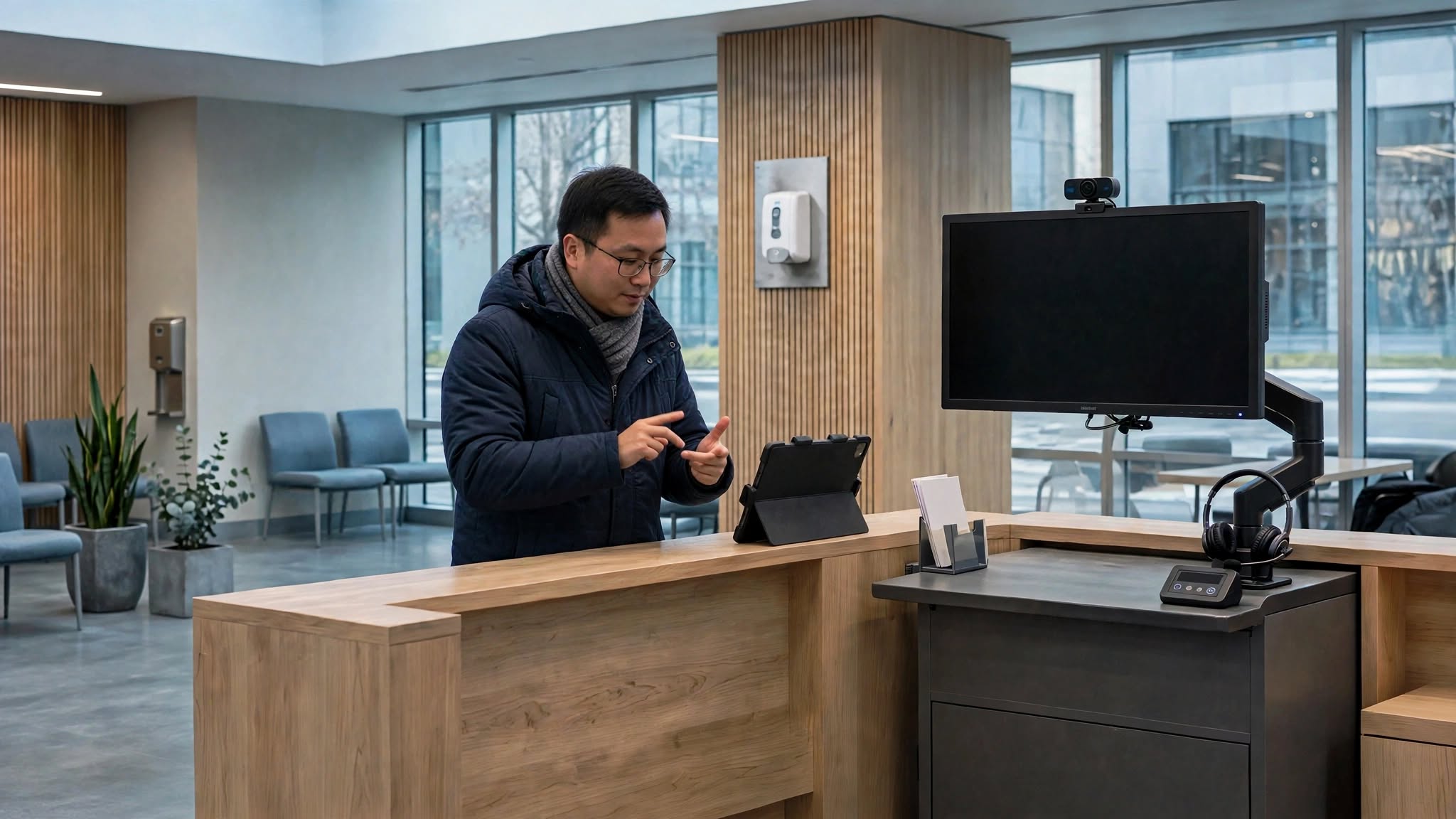
    On-demand VRI provides immediate access when no interpreter has been booked. Staff connect through a platform and are matched with a qualified ASL or LSQ interpreter within seconds from a laptop, tablet, or mobile device. It is designed for unplanned or urgent needs that cannot wait for scheduling.

    Each method solves a different operational problem. Treating them as interchangeable creates gaps. Treating them as complementary closes those gaps.

    Matching the Method to the Situation

    A clear hybrid model assigns each approach to the situations it handles best:

    • Use scheduled interpreting when the need is known in advance and preparation adds value.
    • Use in-person interpreting for complex, lengthy, or high-stakes interactions where physical presence is important.
    • Use on-demand VRI for walk-ins, urgent inquiries, last-minute needs, and any situation where waiting or rescheduling is not acceptable.

    This structure gives front-line teams clear guidance and reduces the risk of defaulting to incomplete workarounds when an unexpected need arises.

    Why a Hybrid Approach Works for Government and Crown Services

    Public-sector environments regularly produce both planned and unplanned communication needs. Relying only on scheduled or in-person interpreting leaves the “right now” moments uncovered. Relying only on on-demand VRI may miss the benefits of preparation and physical presence for more complex interactions.

    A hybrid strategy delivers:

    • Coverage for both anticipated and unexpected needs
    • Greater consistency across locations, shifts, and service channels
    • Reduced pressure on staff who previously had limited options
    • Stronger alignment between accessibility commitments and daily operations

    On-demand VRI does not replace scheduled or in-person services. It fills the critical space between them.

    Implementing the Strategy

    Successful hybrid models usually include three practical elements:

    1. Clear internal guidance so staff know which option to use and how to access it.
    2. Reliable on-demand capability that meets professional standards for ASL and LSQ interpreting.
    3. Continued investment in scheduled and in-person services for the situations that require them.

    When these pieces are in place, accessibility becomes more consistent and less dependent on whether someone remembered to book ahead.

    A Practical Next Step

    Review a recent period of service interactions and identify how often communication needs arose without advance notice. Those instances point directly to where on-demand VRI strengthens the overall model.

    A hybrid strategy is not theoretical. It is a working combination of planned support, physical presence when needed, and immediate access when timing cannot wait.

    Visit asign.ca to explore how on-demand ASL and LSQ interpreting can complement your existing scheduled and in-person services, or reach out to discuss a hybrid approach tailored to your government or Crown operations.

    Three methods. One goal: reliable access in every situation that matters.
  • How to Choose an On-Demand VRI Platform That Meets Public-Sector Requirements (Security, Quality, Speed)

    How to Choose an On-Demand VRI Platform That Meets Public-Sector Requirements (Security, Quality, Speed)

    Provincial, municipal, federal, and Crown organizations evaluating on-demand video remote interpreting (VRI) face a clear set of operational requirements. The platform must deliver professional ASL and LSQ interpreting quickly, maintain high quality, and meet the security expectations of public-sector environments.

    Choosing well means looking beyond marketing claims and focusing on three core dimensions: security, quality, and speed.

    1. Security: Protecting Sensitive Information

    Public-sector interactions frequently involve personal, financial, health, or regulated information. A suitable VRI platform should support:

    • Interpreters who can hold appropriate security clearances (Reliability through Top Secret where required)
    • Secure connection protocols and data handling practices aligned with government expectations
    • Clear policies on confidentiality and professional ethics

    Ask providers to explain how they manage security requirements and whether their interpreter pool includes individuals cleared for the levels your organization needs.

    2. Quality: Professional Standards and Language Coverage

    Speed without quality creates new risks. Quality in Canadian VRI rests on two foundations: qualified interpreters and reliable coverage of both ASL and LSQ.

    Key indicators include:

    • Interpreters who meet recognized professional standards and belong to established associations
    • CASLI (Canadian Association of Sign Language Interpreters) — the national body for ASL-English interpreters, managing the Canadian Evaluation System (CES) and Certificate of Interpretation (COI)
    • AQILS (Association québécoise des interprètes en langues des signes) — the professional association representing sign language interpreters (including LSQ and ASL) in Quebec, focused on ethics, certification standards, and professional development
    • WAVLI (Westcoast Association of Visual Language Interpreters) — the provincial association for ASL-English interpreters in British Columbia, which holds legislative title protection for Registered ASL-English Interpreter and related titles

    A strong platform draws on interpreters affiliated with these (or equivalent) bodies and provides consistent, high-quality service in both ASL and LSQ across regions.

    3. Speed: Access Measured in Seconds, Not Minutes

    The defining value of on-demand VRI is immediate availability. Evaluate:

    • Average time from request to live interpreter
    • Performance during peak periods
    • Ease of launching a session from standard devices (laptop, tablet, or mobile) with minimal training

    If staff cannot connect quickly under real service-counter or office conditions, the platform will see limited use precisely when it is needed most.

    Putting the Three Requirements Together

    A platform that excels in only one or two areas leaves gaps. Public-sector teams need all three working together:

    • Security that meets organizational and regulatory expectations
    • Quality grounded in professional standards, association affiliation, and full ASL/LSQ coverage
    • Speed that delivers an interpreter in seconds rather than creating new delays

    When these elements are present, on-demand VRI becomes a reliable complement to scheduled interpreting — closing the gap for unplanned interactions without compromising standards.

    A Practical Evaluation Approach

    Before deciding, request clear answers on connection times, interpreter qualifications and affiliations (CASLI, AQILS, WAVLI or equivalent), available security clearances, and how the platform performs in typical public-facing environments. Where possible, observe a live demonstration under conditions that resemble your actual service settings.

    The right choice supports both accessibility commitments and day-to-day operational reality.

    Visit asign.ca to explore how on-demand ASL and LSQ interpreting can meet public-sector requirements for security, quality, and speed, or reach out to discuss the criteria that matter most for your organization.

    Security. Quality. Speed. All three are non-negotiable for public-sector access that works.