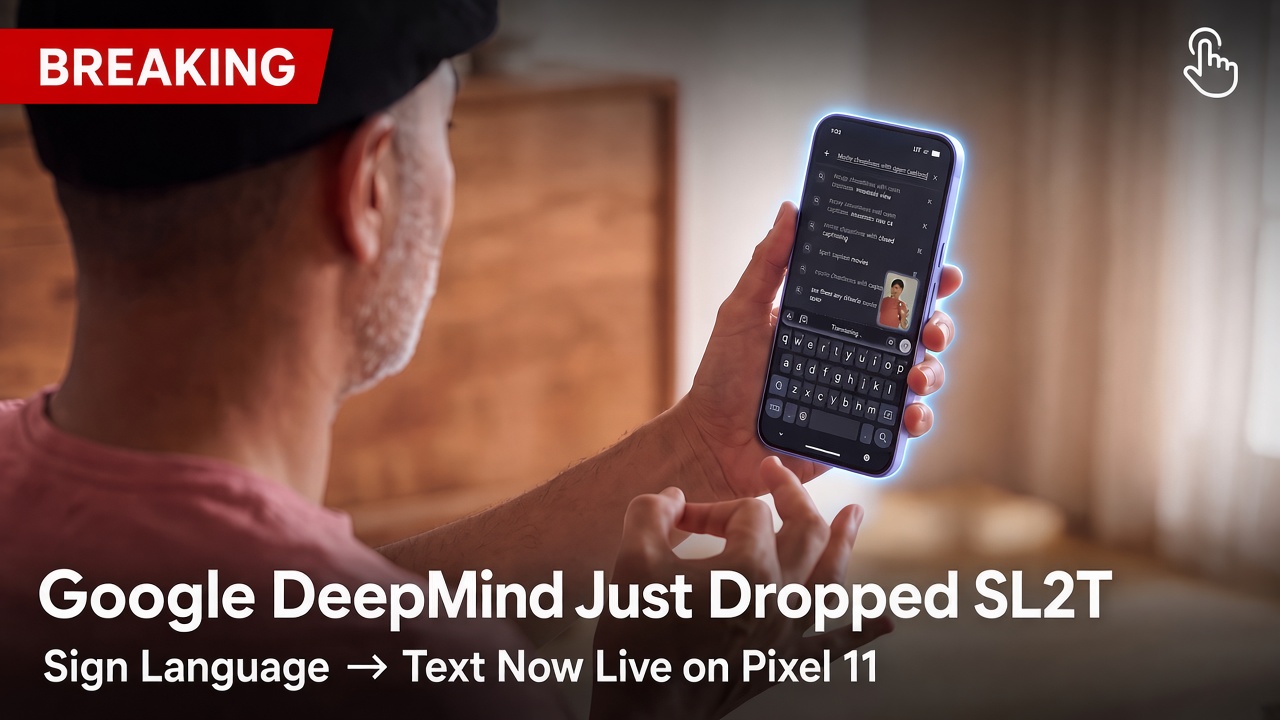
Google DeepMind just made one of the most meaningful accessibility advances in AI this year. On August 12, 2026, the company unveiled SL2T (Sign-Language-to-Text), a breakthrough model that finally brings high-quality sign language recognition out of the research lab and onto everyday smartphones.
Starting with the Pixel 11, SL2T powers a new “sign-to-text” feature in Gboard and Live Transcribe. For the first time, Deaf and hard-of-hearing users can sign in American Sign Language (ASL) directly to their phone camera instead of typing. The phone turns those signs into English text in real time.
What SL2T Actually Lets You Do
Anywhere you would normally type on your Pixel 11, you can now sign:
- Search the web
- Draft messages, emails, or documents
- Ask Gemini questions or give it tasks
- Respond in face-to-face conversations using Live Transcribe
Early testers told Google that signing in ASL felt faster and more natural than typing English. That alone is a big deal for people who use sign language as their primary language.
How the Technology Works
SL2T is deliberately designed with privacy and real-world usability in mind.
An on-device model called MediaPipe Holistic tracks roughly 130 key points on the signer’s face, hands, arms, and torso. Only those geometric coordinates are sent to the cloud for translation. The original video is discarded immediately and never leaves the device.
Unlike earlier systems that relied on intermediate “glosses” (fixed labels for individual signs), SL2T translates the sequence of pose landmarks directly into fluent English text. This approach better captures the simultaneous hand, body, and facial movements that give sign languages their full grammatical structure.
The model was trained on more than 100,000 hours of signing data across over 50 sign languages, with about a quarter of that data in ASL. Training across many languages helped it learn shared patterns and improved performance.
Performance and Real-World Readiness
On the challenging FLEURS-ASL benchmark, SL2T scored 70 BLEURT in a zero-shot setting — significantly higher than previously reported results. It also performs well on one-handed signing (important when you’re holding a phone) and reaches 64% exact-match accuracy on mobile fingerspelling data.
Google specifically optimized for practical issues: lower latency, reduced hallucination when no one is signing, support for left-handed signers, and one-handed use.
Built With the Deaf Community, Not Just for It
The project began with Sam Sepah, a Deaf Googler, and Deaf perspectives shaped data collection, testing, and evaluation throughout development.
Google also established the AI Sign Language Advisory Committee (AISLAC), which includes major organizations such as the National Association of the Deaf and the World Federation of the Deaf. Together they published a joint impact report that clearly defines what SL2T 1.0 is — and is not — intended for.
The report positions the current version as an assistive tool for informal, low-stakes situations such as messaging, searching, note-taking, and casual conversation. It explicitly states that SL2T should not be used as a substitute for certified interpreters in medical, legal, educational, or official settings, and it does not fulfill legal requirements for reasonable accommodations.
What’s Coming Next
ASL-to-English on Pixel 11 is only the starting point. Google plans to expand support to additional sign languages, improve handling of non-manual markers and multi-signer scenarios, add features like punctuation and editing commands, and eventually explore sign language generation.
The longer-term goal is full parity: making sign languages as accessible and useful across digital products as spoken and written languages already are.
Why This Matters
An estimated 70 million people worldwide are Deaf or hard of hearing, and there are more than 200 distinct sign languages. While speech recognition and translation have advanced rapidly, sign language AI has lagged far behind — partly because of technical complexity and partly because of longstanding misconceptions about how sign languages work.
SL2T does not solve every challenge overnight. Accuracy still drops in poor lighting, extreme camera angles, or with rapid fingerspelling of rare words. But for the first time, a capable sign-language-to-text system is available as a free, everyday feature on a mainstream smartphone.
That is genuine progress. And for many users, it means their primary language can finally work with the devices they already carry every day.
SL2T is available now on Pixel 11 in Gboard and Live Transcribe, with broader device support planned. No extra cost.