Category: Deaf Culture

  • Did You Know What Alexander Graham Bell’s Legacy Means to the Deaf Community?

    Did You Know What Alexander Graham Bell’s Legacy Means to the Deaf Community?

    Did you know that Canada recently revisited how Alexander Graham Bell is officially remembered?

    If you’re part of the Deaf community or have studied Deaf history, you may already know about Bell’s influence on Deaf education, oralism, sign language and eugenics.

    But if you don’t, you may know him primarily as the inventor of the telephone.

    And that is exactly why I think this conversation deserves more attention.

    Because Alexander Graham Bell’s legacy is not only a story about invention and innovation.

    It is also part of Deaf history.

    And when Canada decides how Bell should be remembered, I believe the Deaf community should have a meaningful voice in that conversation.

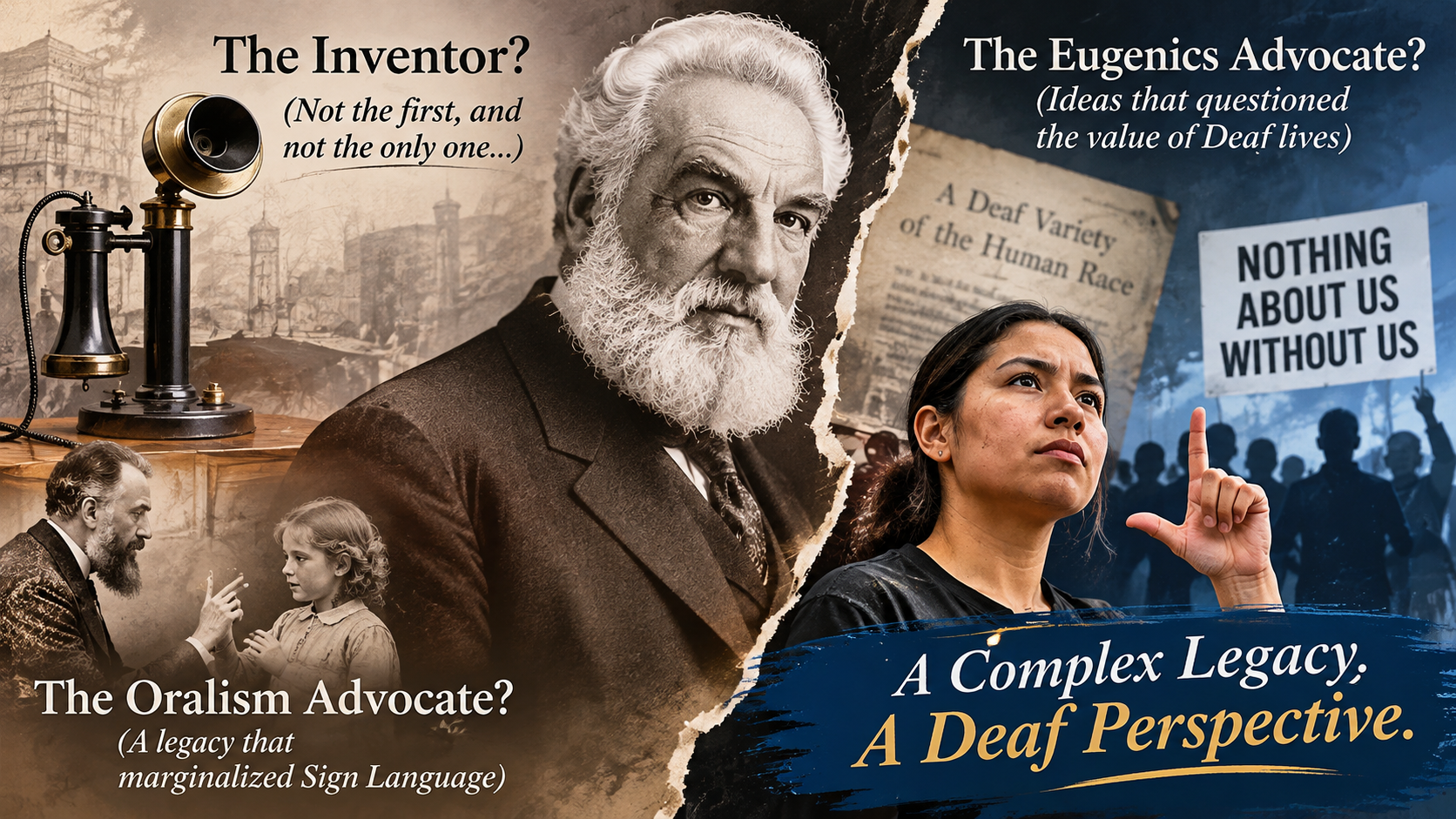
    Bell’s legacy looks very different from a Deaf perspective

    For much of the general public, Bell represents innovation.

    The telephone.

    Scientific achievement.

    Communication.

    Canadian history.

    But for many Deaf people, his name carries another meaning.

    Bell was one of the most influential advocates of oralism in Deaf education.

    He promoted speech-based education and opposed the use of sign language as the primary language of instruction for Deaf children. He also opposed Deaf people becoming teachers of Deaf children, believing they could not effectively teach speech and articulation.

    His influence contributed to an educational system that increasingly prioritized speech and lipreading while pushing sign language and Deaf educators to the margins.

    The consequences of that history lasted for generations.

    This wasn’t simply a disagreement over teaching methods.

    It was about language, identity, education, culture and power.

    It was about who had the authority to decide what Deaf children needed.

    And most importantly, Deaf people themselves were often not the ones making those decisions.

    The Dictionary of Canadian Biography documents how oral education expanded significantly while concerns from Deaf representatives who opposed exclusive oralism went unheard.

    From a Deaf community perspective, that history cannot simply be separated from Bell’s celebrated accomplishments.

    But even the telephone story is more complicated than we were taught

    There is another reason I think we should be willing to look more closely at Bell’s legacy.

    Many of us grew up with a very simple version of the story:

    Alexander Graham Bell invented the telephone.

    But the history of the telephone was much more complicated than that.

    Bell was certainly a major figure in its development. He obtained the famous U.S. Patent No. 174,465 in 1876 and went on to develop and commercialize a working telephone system. The Library of Congress notes that Bell is conventionally credited as the inventor because of his patent and successful development of a working device.

    However, Bell was not the first person to experiment with transmitting speech electrically.

    Italian inventor Antonio Meucci developed an early voice-communication device in the 1850s and filed a patent caveat in 1871. Due to financial difficulties, Meucci was unable to renew that caveat after 1874. Bell later obtained the telephone patent in 1876.

    The U.S. House of Representatives subsequently passed a resolution in 2002 recognizing Meucci’s life, achievements and contribution to the invention of the telephone.

    There were also other important contributors, including Johann Philipp Reis and Elisha Gray. The Library of Congress describes the history as a contentious invention story involving several people working toward similar breakthroughs.

    So even the familiar story of Bell as the singular inventor is more complicated than the version many of us learned.

    And I think that matters because it illustrates a broader point:

    Historical narratives often become much simpler than the history itself.

    A complicated story becomes a single name.

    A collection of contributors becomes one celebrated individual.

    And the experiences of people affected by that person’s work can disappear from the story altogether.

    That is exactly what I don’t want to happen with Deaf history.

    Then there is the eugenics connection

    This is the part that I think deserves considerably more public awareness.

    In 1884, Bell published Upon the Formation of a Deaf Variety of the Human Race.

    He expressed concern about Deaf people forming communities, socializing with one another and marrying other Deaf people.

    He feared that this could lead to what he described as a “deaf race.”

    Gallaudet University’s National Deaf Life Museum documents this history and explains how Bell’s ideas became influential within the oralist movement and intersected with eugenic thinking.

    Bell’s ideas about heredity and Deafness were not merely theoretical.

    They contributed to a broader social environment in which Deaf people were increasingly viewed through the lens of preventing or reducing Deafness.

    That should matter to us today.

    Because when society begins asking whether Deaf people should exist, whether Deaf children should be born, or whether Deafness should be prevented, we are no longer simply talking about history.

    We are talking about the value society places on Deaf lives.

    But history needs nuance

    As a Deaf advocate, I don’t think we strengthen this conversation by reducing Bell to a cartoon villain.

    The historical record is more complicated than that.

    Parks Canada’s revised designation acknowledges that Bell held eugenics-related beliefs and argued against intermarriage among congenitally Deaf people. But it also acknowledges that he opposed segregation, institutionalization, sterilization and legislative bans on intermarriage, and eventually abandoned formal involvement in eugenics organizations.

    Academic historians have similarly emphasized the complexity of Bell’s relationship with eugenics. Brian Greenwald and John Vickrey Van Cleve, for example, describe Bell as becoming entangled in the eugenic environment of his time while also attempting to prevent eugenicists from interfering with Deaf people’s reproductive rights.

    That distinction is important.

    We should not claim that Bell supported every coercive eugenic policy.

    But we also shouldn’t use those distinctions to erase his documented beliefs and influence.

    Both parts of the history deserve to be told.

    So why is this important now?

    Because Canada has actually done something significant.

    In 2025, the Historic Sites and Monuments Board of Canada reviewed Bell’s designation as a National Historic Person.

    Parks Canada subsequently revised the official reasons for his designation to acknowledge his oralist advocacy, discouragement of sign language and eugenics-related beliefs.

    That is not just a historical footnote.

    It is a change in how Canada officially remembers one of its most famous historical figures.

    And yet, I have to ask:

    How many Canadians know about it?

    And perhaps even more importantly:

    How many Deaf Canadians know about it?

    I’m not asking because I believe nobody in the Deaf community knows.

    Deaf historians, scholars, educators and community members have been discussing Bell’s legacy for decades.

    The issue is whether this particular development has reached the broader Deaf community and whether Deaf people have been meaningfully included in the process of determining how this history is represented.

    Those are two different things.

    Who gets to tell Deaf history?

    This is where I believe we need to go beyond simply asking whether Parks Canada got the history right.

    We should also ask:

    Who was involved in telling it?

    Parks Canada states that its designation review process can involve subject-matter experts, implicated communities, stakeholders and local communities.

    That’s important.

    But as a Deaf advocate, I want to know more.

    Were Deaf organizations consulted?

    Were Deaf historians and Deaf Studies scholars involved?

    Were Deaf community members given opportunities to contribute?

    What perspectives did they provide?

    How did those perspectives influence the final decision?

    And perhaps most importantly:

    How was the outcome communicated back to the Deaf community?

    Because there is a difference between having a consultation process and having meaningful Deaf participation.

    There is a difference between talking about Deaf people and creating space for Deaf people to shape the story.

    And there is a difference between making historical information technically accessible and making sure it actually reaches the community whose history is being discussed.

    This is about more than Alexander Graham Bell

    Bell is one person.

    But the larger issue is much bigger.

    For generations, Deaf people were told that speech was better than sign language.

    Deaf children were placed in educational systems designed around hearing norms.

    Deaf teachers were pushed aside.

    Sign languages were discouraged or prohibited.

    And decisions about Deaf people’s lives were frequently made without Deaf people having meaningful authority.

    This is part of our history.

    It is also part of the reason Deaf communities today continue to advocate for:

    Deaf-led education.

    Deaf leadership.

    Sign language rights.

    Deaf representation.

    Nothing about us without us.

    These aren’t simply modern slogans.

    They are responses to a very long history of decisions being made about Deaf people without Deaf people.

    And this is where Bell’s legacy becomes relevant today

    We might be tempted to say:

    “That was over a hundred years ago.”

    But some of the questions Bell’s legacy raises are still with us.

    Who decides what communication method a Deaf child should use?

    Who decides what constitutes a successful Deaf education?

    Who decides whether sign language is essential?

    Who decides whether Deaf people should be represented in decisions affecting Deaf children?

    And increasingly:

    Who gets to decide whether Deafness itself should exist?

    Today, we are having conversations about genetic testing, gene editing and technologies that could potentially prevent or alter Deafness.

    Those conversations are not identical to the eugenics debates of Bell’s era.

    But the historical connection is important.

    Whenever society discusses eliminating a characteristic from future generations, we need to ask:

    What are we saying about the people who already live with that characteristic?

    For Deaf people, Deafness isn’t simply a genetic condition to be corrected.

    It can be language.

    It can be culture.

    It can be community.

    It can be identity.

    It can be connection.

    It can be a way of experiencing the world.

    That perspective needs to be present in conversations about our future.

    Bell married a Deaf woman. Does that change the story?

    This is one argument that has emerged from Bell’s descendants.

    Bell’s wife, Mabel Hubbard Bell, was Deaf. Bell communicated with her and supported her in many ways.

    His descendants have also pointed to his statements supporting an individual’s freedom to marry whom they chose.

    Those facts are real and should not be ignored.

    But they don’t erase the larger historical record.

    A person can love and respect individual Deaf people while holding ideas that negatively affect Deaf people as a group.

    A person can have a Deaf spouse while advocating educational practices that marginalize Deaf language and Deaf teachers.

    A person can oppose government-enforced marriage restrictions while still warning Deaf people about marrying other Deaf people.

    Human beings are capable of holding contradictory beliefs.

    History doesn’t become clearer when we remove those contradictions.

    It becomes clearer when we examine them.

    What should Canada do with Bell’s legacy?

    I don’t believe the answer is to erase him.

    I don’t believe the answer is to remove every reference to him.

    And I don’t believe we should pretend his scientific and technological contributions didn’t happen.

    Instead, I believe Canada should tell the whole story.

    If visitors learn about Bell’s contributions to communication, they should also be able to learn about his influence on Deaf education.

    If his work in science is celebrated, his writings about hereditary Deafness should not be hidden.

    If his historic site tells his story, Deaf people’s experiences should be part of that interpretation.

    And if Canada is going to reconsider his historical designation, Deaf perspectives should be visible in that process.

    Not as an afterthought.

    Not as a footnote.

    Not simply as another stakeholder.

    As people whose history is directly connected to the story being told.

    We need more Deaf voices in the conversation

    This is perhaps the biggest reason I’m writing about this.

    Not because I think everyone needs to agree on Alexander Graham Bell.

    Not because I want to tell people what conclusion they should reach.

    And not because I think history should be rewritten to make us comfortable.

    I’m writing because Deaf history needs to be part of public history.

    For too long, Deaf history has existed in spaces that many people outside the Deaf community never encounter.

    Our stories are taught in Deaf schools, Deaf Studies programs, museums, archives, community organizations and within Deaf communities.

    But when national institutions tell Canadian history, those stories need to be there too.

    And when they are there, Deaf people need to be involved in telling them.

    That’s what Deaf leadership and representation should look like.

    So, did you know about this?

    If you already knew, I would love for you to continue the conversation.

    If you didn’t, I hope this gives you a reason to learn more.

    Read the historical research.

    Look at Bell’s own writings.

    Read the Parks Canada designation.

    Learn about the history of oralism.

    Learn about the Deaf people who challenged it.

    And, most importantly, listen to Deaf historians, Deaf scholars and Deaf community members who have been carrying this history for generations.

    Because this isn’t simply the story of Alexander Graham Bell.

    It’s part of our story.

    And when Canada decides how that story is remembered, Deaf people deserve a seat at the table.

    Not because we want to erase history.

    Not because we want to rewrite history.

    But because nothing about us should be remembered without us.
  • In Flanders Fields | An ASL Adaptation for Remembrance Day

    Here’s an ASL adaptation of In Flanders Fields by Lieutenant-Colonel John McCrae for Remembrance Day.

    May we remember those who served and sacrificed.

    Lest we forget. 🌺

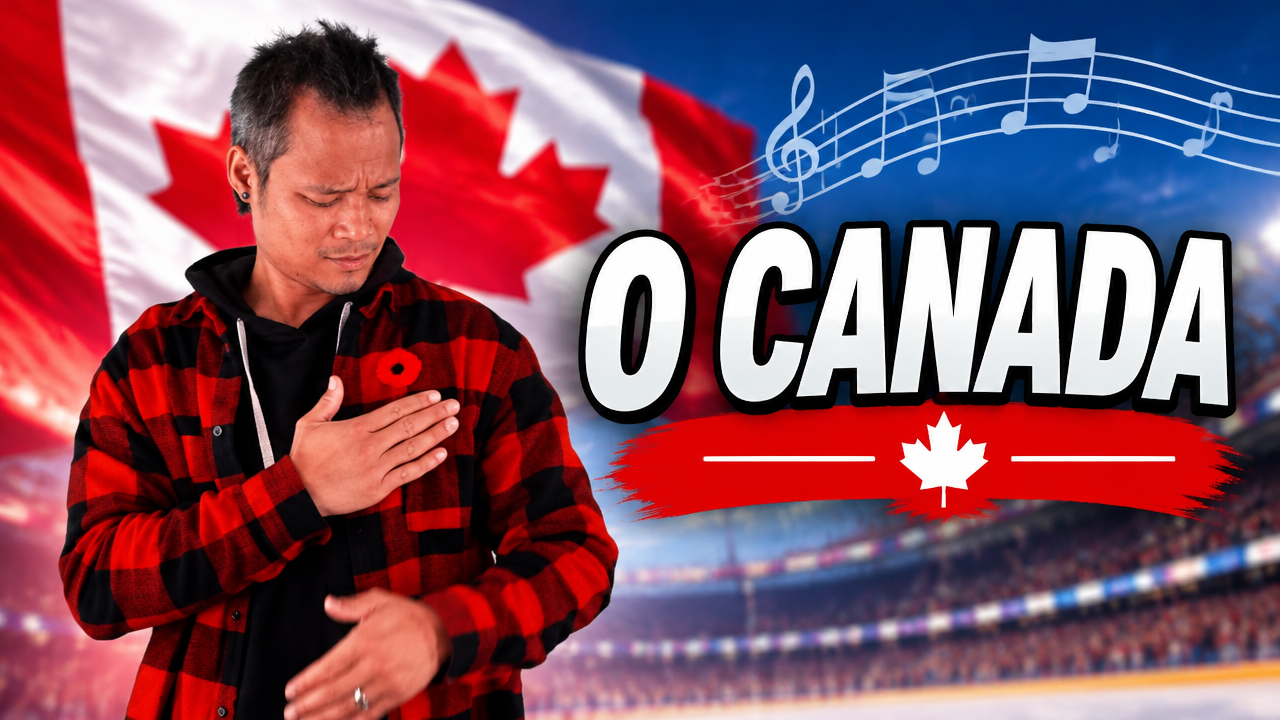
  • Behind the Signs: Preparing to Perform O Canada in ASL and LSQ at the Heritage Classic

    Behind the Signs: Preparing to Perform O Canada in ASL and LSQ at the Heritage Classic

    Since the Heritage Classic, there’s been quite a bit of activity and conversation within the Deaf community surrounding my performance of O Canada in American Sign Language (ASL) and Langue des signes québécoise (LSQ).

    The video has garnered at least 30,000 views since I shared it, along with comments, shares and messages from people across the Deaf community.

    But there’s something many people may not know: the video I shared wasn’t actually the live broadcast of the performance. It was a recreation.

    During the Heritage Classic, I was introduced on the stadium screen at the beginning of the anthem. However, once the performance started, the camera shifted away from me and focused on SoulBear, the fans and the hockey players. As a result, the signing wasn’t visible for the majority of the performance.

    I subsequently received messages from Deaf Canadians expressing their disappointment that they couldn’t see the national anthem being performed in ASL and LSQ. For many, this was another reminder that accessibility isn’t just about having someone present. It’s also about making sure Deaf people can actually see and experience the performance.

    That’s why I decided to recreate the performance and share it publicly. I wanted the Deaf community to have the opportunity to experience what they had missed.

    There’s another aspect of this performance that makes it particularly meaningful. To my knowledge, this was the first documented performance of Canada’s national anthem bringing together all four languages: English, French, ASL and LSQ.

    Getting the representation right

    When I was initially informed that the national anthem would be performed in English and French, I was advised to translate the French lyrics into English first, then interpret the English version into ASL.

    However, I felt that approach would miss something important.

    Canada has two official spoken languages, English and French, but we also have distinct sign languages. ASL and LSQ are recognized under the Accessible Canada Act as primary languages for communication by Deaf people in Canada.

    In many contexts, ASL is associated with English-speaking Deaf communities, while LSQ is associated with French-speaking Deaf communities. They are distinct languages, each with its own linguistic and cultural identity.

    I wanted the performance to reflect that reality.

    The Heritage Classic featured the Winnipeg Jets and the Montreal Canadiens. It was a distinctly Canadian event, bringing together two teams and communities with their own linguistic and cultural connections. It would have felt incomplete to represent the anthem in English, French and ASL without also considering LSQ.

    I explained why having both sign languages was important. This meant going beyond simply translating words from one language into another. It was about recognizing Deaf Canadians and ensuring that both linguistic communities were represented.

    Learning, reaching out and taking on a challenge

    This is where the preparation became more involved.

    I started researching and reaching out to trusted members of the LSQ community, particularly professionals who were bilingual in ASL and LSQ. Ideally, I would have preferred to have someone who was genuinely fluent in both languages take on the performance alongside me.

    Unfortunately, there wasn’t anyone locally available at the time, and bringing someone in from outside the city wasn’t feasible.

    I decided to take on the responsibility myself.

    That meant receiving one-on-one LSQ coaching, practising the French portions of the anthem and making sure I was representing the language as accurately and respectfully as possible. I didn’t want to simply memorize signs and hope for the best. I wanted to understand what I was signing and ensure the LSQ portions were presented appropriately.

    It was a learning experience that required time, preparation and humility. I recognized that knowing ASL didn’t automatically mean I knew LSQ. They are different languages, and I needed guidance from people with the appropriate linguistic knowledge and experience.

    I’m grateful to those within the LSQ community who shared their expertise and helped me prepare.

    Catching the LSQ bug

    I’ve always been interested in learning LSQ, but I never really had a strong reason to use it regularly. Living in Winnipeg, my everyday interactions are primarily in ASL, and opportunities to use LSQ are relatively limited.

    This experience changed something for me.

    Through the preparation, coaching and exposure to LSQ, I developed an even greater appreciation for the language and its community. I found myself wanting to continue learning beyond what was needed for the performance.

    With English and French being Canada’s official languages, I also felt that developing a better understanding of LSQ was a meaningful way to deepen my connection to Canada’s linguistic landscape and Deaf communities.

    I may have started learning LSQ because of the Heritage Classic, but I don’t want it to end there. I’ve caught the LSQ bug, and I’m looking forward to continuing that learning journey.

    More than 30,000 views, but what matters most

    Since sharing the recreated performance, the video has continued to reach people well beyond my immediate network. The views, comments, shares and saves have been encouraging.

    I’ll admit, it feels good to know that something I worked so hard to prepare is making an impact, especially within the Deaf community across Canada.

    But the numbers aren’t really what make this meaningful.

    It’s the messages from Deaf Canadians who were excited to finally see the performance. It’s the appreciation for including LSQ alongside ASL. It’s the conversations about representation, accessibility and what it means to see our languages represented on a national stage.

    This experience reminded me that visibility matters. But visibility alone isn’t enough. Representation needs to be intentional, meaningful and grounded in the communities and languages being represented.

    I’m proud to have been part of this moment alongside SoulBear, who brought the anthem to life through English and French, while we worked together to bring ASL and LSQ into the performance.

    And perhaps one of the biggest takeaways for me is that this experience has opened another door. What started as an opportunity to perform Canada’s national anthem became an opportunity to learn, collaborate and develop a deeper appreciation for another sign language community in Canada.

    Four languages. One national anthem. And a reminder that Deaf Canadians belong in the moments where our country comes together.

    That’s something worth continuing to build on.

  • Why Winnipeg Roars “TRUE NORTH!” (And Why I’ll Sign It That Way Tomorrow)

    Why Winnipeg Roars “TRUE NORTH!” (And Why I’ll Sign It That Way Tomorrow)

    Here’s the story of how Winnipeg lost its Jets… and how a quiet, stubborn group of locals brought them home.

    It starts with a sound you’ll only ever hear in one building on the Prairies.

    The lights are low. Fifteen thousand people are on their feet. The anthem singer reaches the line that every Canadian knows by heart—the True North strong and free—and the entire arena erupts as one:

    “TRUE NORTH!”

    It’s not in the official lyrics. It never was. Yet it feels more Winnipeg than almost anything else in the song. That shout is pure gratitude, pure pride, and a little bit of unfinished business. To understand why it hits so hard, you have to go back to the night the city went quiet.

    In the spring of 1996, the Winnipeg Jets played their last game at the old Winnipeg Arena. The building was aging. The team was losing money. Ownership couldn’t find a way to stay. On a warm July day the franchise was sold to American interests and shipped south to become the Phoenix Coyotes. Just like that, the Jets were gone.

    For a lot of people here, it felt personal. Hockey wasn’t just entertainment. It was the winter heartbeat of the city. Kids had grown up dreaming of wearing that crest. Parents had spent paycheques on season tickets. When the moving trucks left, something in the civic spirit left with them. Downtown felt emptier. Winters felt longer. People still talk about where they were when they heard the news, the way people remember where they were during a blackout.

    What followed were the lean years. No NHL. No big nights. Just the ache of what used to be. Some cities might have let the dream die. Winnipeg didn’t. A small group of local business people, led by Mark Chipman, refused to accept that the story was over. In 1996—while the wounds were still fresh—they brought the Minnesota Moose north and rebranded them the Manitoba Moose. It wasn’t the NHL, but it kept the ice cold and the seats full. It kept the habit of gathering under one roof for hockey alive.

    Then they did something even more important. They built a real arena.

    The MTS Centre (now Canada Life Centre) rose in the middle of downtown in 2004. It wasn’t flashy by big-city standards, but it was modern, intimate, and owned by people who actually lived here. True North Sports & Entertainment was never just a company name. It was a statement: we’re staying. We’re investing. We’re not waiting for someone else to save us.

    For years they watched. They studied the economics of the new NHL. They talked quietly with the league. Twice they came painfully close to bringing the original Jets franchise home from Phoenix. Once, Chipman later said, they were “within ten minutes” of sealing the deal before Glendale found more money to keep the team. The near-misses hurt, but they also proved something: Winnipeg was ready. The arena was ready. The ownership group was ready. All they needed was the right moment.

    That moment arrived in the spring of 2011.

    The Atlanta Thrashers were struggling. True North moved. On the morning of May 31, Mark Chipman stood in front of the media at the MTS Centre and said the words the city had waited fifteen years to hear. The NHL was coming back. The team would be called the Jets again.

    Tickets went on sale a few days later. Thirteen thousand season tickets sold in seventeen minutes. Grown men cried in the ticket lines. Strangers hugged. For the first time in a generation, Winnipeg felt whole again.

    A few months later, during one of the very first home games, something spontaneous happened. When the anthem reached “the True North strong and free,” a few voices in the crowd shouted the company name that had made the miracle possible. The next night a few more joined in. Then the whole building. No one organized it. No one asked for it. It just happened—the purest kind of thank-you a city can give.

    That’s why, every single time the national anthem plays at a Jets game, the same roar rises. It’s not marketing. It’s memory. It’s the sound of a city that lost something precious, refused to stay broken, and quietly, stubbornly, brought it home.

    So the next time you hear fifteen thousand people shout “TRUE NORTH!” in the middle of “O Canada,” know what you’re really hearing.

    You’re hearing the long winter that followed 1996.
    You’re hearing the people who kept showing up for the Moose.
    You’re hearing the risk of building an arena when no team was guaranteed.
    You’re hearing the almost-deals that fell through and the one that finally didn’t.
    And you’re hearing a city that still remembers what it felt like to lose its team—and refuses to take having it back for granted.

    That’s the story. And every time the chant hits, Winnipeg tells it again.

  • Day 17: Deaf Accessibility Wins – The Rise of ASL on Screen

    For the longest time, seeing ASL on screens was rare. Early exposure often came from educational videos and teaching materials featuring legends like Ben Bahan, Peter Cook, Manny Hernandez, Bonnie Kraft, Sam Supalla, and many others (feel free to add your favourites in the comments!).

    Then came ASL music interpreters in churches and on YouTube. Deaf performers started signing their own songs — Rosa Lee Timm, Russell Harvard, and others. Organizations like DPAN (Deaf Performing Arts Network) also played a big role.

    Mainstream breakthroughs followed: Children of a Lesser God, Deaf actors appearing in sitcoms, and full-length movies in ASL from ASL Films.

    Today, social media has exploded with ASL content, making it more visible than ever.

    This increased exposure is a major win. When more people see ASL on screens — in theatres, TV, and online — it raises awareness and changes how they think about, approach, and interact with Deaf people. Attitudes shift toward openness and understanding.

    Sign language has existed for centuries and has faced suppression, but as George Veditz famously said, “As long as we have Deaf people, there will always be signs.”

    The growing visibility of ASL is proof of that resilience — and a powerful accessibility win for the community.


    What about you? What’s one movie, show, video, or performance that featured ASL and left an impact on you? Or how has seeing more ASL in media changed your perspective?

    Share your favourites or thoughts in the comments!

    See you tomorrow for Day 18!

  • International Mother Language Day: From Recognition to Redesign in Canada

    Today is International Mother Language Day.

    Across Canada, institutions, schools, and organizations marked the occasion by celebrating the languages that shape identity and community. Notably, the Office of the Chief Accessibility Officer publicly acknowledged that communication is one of the seven priority areas under the Accessible Canada Act — and that American Sign Language (ASL), Langue des signes québécoise (LSQ), and Indigenous Sign Languages are recognized as the primary languages of Deaf people in Canada.

    This matters.

    It matters because the Accessible Canada Act formally acknowledges what Deaf communities have always known: our languages are sovereign, complete, and foundational to who we are.

    But let’s be clear.

    Deaf people did not begin existing when legislation recognized us.
    Our languages were not born when they were written into law.
    We have always been here.

    Beyond Celebration: A Strategic Opening

    International Mother Language Day is not simply a celebration of linguistic diversity. It is an opportunity — a strategic opening — to shift from recognition to redesign.

    Recognition says: We see you.
    Design says: We build with you.

    There is a profound difference.

    For generations, Canadian systems — education, healthcare, employment, media, and policy — were constructed on an assumption of speech supremacy. Deaf presence was treated as an exception to accommodate rather than a design reality to centre.

    Now, with ASL, LSQ, and Indigenous Sign Languages acknowledged within federal law, we stand at a threshold.

    The question is no longer whether our languages are valid.

    The question is:

    What will Canada look like when Deaf presence is embedded by design?

    What Does Deaf Presence by Design Mean?

    What would it mean to:

    • Build policies that begin from visual language, not retrofit it?
    • Structure organizations where sign language is not a service line item but a foundational operating modality?
    • Design businesses where Deaf professionals shape strategy, not merely participate in it?
    • Create public communications that assume visual-spatial language users from the outset?

    This is not about “inclusion.” Inclusion implies an existing structure with space made at the edges.

    This is about architectural influence.

    Deaf Canadians are not guests in this country. We are co-authors of it.

    Language as Activation

    International Mother Language Day reminds us that language is identity.

    But within the Sumain frame, language is also activation.

    When ASL is centred in a household, it is not an accommodation. It is inheritance.
    When LSQ shapes community in Québec, it is not a special feature. It is culture in motion.
    When Indigenous Sign Languages are acknowledged, we are reminded that Deaf presence has always intersected with land, nationhood, and sovereignty.

    Recognition under the Accessible Canada Act is significant. It gives us a legal foothold. It gives advocates leverage. It gives institutions direction.

    But legislation alone does not redesign landscapes.

    People do.

    Moving From Gratitude to Authorship

    This moment is an invitation — especially for Deaf leaders, entrepreneurs, educators, artists, policymakers, and families — to move beyond gratitude and into authorship.

    How will we influence:

    • The next generation of policy?
    • The structure of Deaf-led enterprises?
    • The training of architects, urban planners, and technologists?
    • The narrative Canada tells about communication, cognition, and human diversity?

    We are not waiting to belong.
    We already do.

    International Mother Language Day is a reminder that our languages are not peripheral to Canada’s story. They are integral to it.

    The future Canadian landscape — socially, economically, and politically — can be shaped with Deaf presence by design.

    The law has acknowledged our languages.

    Now we activate them.

    Start reframing now.

  • “It’s Accessible—It Has Captions”: Why That Assumption Still Excludes Deaf People in Canada

    As a Deaf dad, accessibility is not an abstract concept for me. It shows up in my work, my parenting, my community involvement, and in the everyday digital spaces my family and I navigate. It also shows up in conversations—often small, well-intentioned ones—that reveal how misunderstood Deaf accessibility still is.

    One such conversation recently took place on a social media messaging platform, and it highlighted a gap that many hearing content creators don’t realize exists.

    The creator reached out to me first, likely in the context of business, leads, or collaboration. She shared about her regular content posting and YouTube channel. As someone grounded in Deaf culture and accessibility work, I saw an opportunity to gently raise awareness about how her content could be more accessible to Deaf audiences—particularly Deaf leads, prospects, and clients.

    I suggested incorporating American Sign Language (ASL) for key videos, such as signed translations or interpretations.

    Her response was:

    “But it’s accessible with captions! And it’s my understanding most Deaf people can read English.”

    The exchange was polite and not hostile. Yet it reflected several deeply rooted misconceptions about Deaf accessibility—misconceptions that remain widespread in Canada. This experience is worth sharing not to single out one person, but to raise awareness about a systemic issue that continues to shape who is included and who is left out online.


    Captions Are Important—But They Are Not the Same as Access

    Captions play an important role in accessibility. They help many Deaf and hard-of-hearing people access spoken content, and when done well, they can include speaker identification and sound cues.

    However, captions alone are not an equivalent solution for the Deaf community.

    ASL Is a First Language for Many Deaf People

    For many Deaf Canadians—especially those who are prelingually Deaf and culturally Deaf—ASL is their first and primary language. ASL is not English on the hands. It is a fully developed visual language with its own grammar, syntax, and cultural meaning.

    ASL is experienced through movement, facial expression, and spatial relationships—not through reading text. When captions are presented in English, they assume fluency in a language that may be a second language for many Deaf people.

    In the Canadian context, this also includes la langue des signes québécoise (LSQ) and Indigenous sign languages used in some communities. Deaf Canadians are linguistically diverse, and English is not automatically the most accessible option.

    Captions Increase Cognitive Load

    Reading captions while watching visuals requires constant eye movement and mental processing. This can be especially challenging for fast-paced, technical, or emotionally nuanced content—particularly when captions are auto-generated and inaccurate (often referred to as “craptions”).

    ASL naturally conveys tone, emphasis, emotion, and intent through non-manual signals. For native signers, ASL often provides a clearer and more complete experience than written English captions.

    The Deaf Community Is Not One-Size-Fits-All

    Some Deaf people rely on captions. Some rely on ASL. Many prefer both. Needs vary depending on age of language exposure, education, identity, and access history.

    The statement “most Deaf people can read English” reflects a common assumption, but it oversimplifies reality. Research consistently shows wide variation in English literacy among Deaf individuals—largely due to language deprivation and systemic barriers in education.

    Assuming captions are sufficient for “most” people inevitably excludes those who already face the greatest barriers.


    What Canadian Deaf-Led Advocacy Has Long Said

    These issues are not new. Deaf-led organizations in Canada have been clear for decades:

    • The Canadian Association of the Deaf – Association des Sourds du Canada (CAD-ASC) advocates for the recognition and use of ASL, LSQ, and Indigenous sign languages. CAD-ASC played a key role in shaping the Accessible Canada Act, which explicitly names these sign languages in federal law and affirms the right to accessible communication.
    • The Canadian Hard of Hearing Association (CHHA) promotes accessible communities while recognizing the diverse communication needs across Deaf and hard-of-hearing populations.
    • Canadian service providers such as Asign demonstrate how sign language interpreting, translation, and on-demand solutions remove real-world communication barriers in workplaces, education, and digital spaces.

    These perspectives align with international standards like the Web Content Accessibility Guidelines (WCAG), which recognize sign language as a necessary accessibility option—not an enhancement—for prerecorded content.


    “But It’s Accessible”: A Hearing-Centred Starting Point

    The response I received reflects a common hearing-centred mindset: captions are seen as “doing accessibility,” often based on general advice rather than Deaf input.

    The phrase “my understanding” matters. It signals reliance on assumptions rather than lived experience or Deaf-led knowledge. This is not about blame. Many hearing creators simply haven’t been exposed to Deaf linguistic realities.

    As a Deaf dad, I see how these assumptions show up everywhere—from online content to education systems to public services. They are rarely intentional, but their impact is real.


    Moving Toward Meaningful Accessibility

    Accessibility is not about perfection. It’s about choice, equity, and listening.

    Practical steps for Canadian content creators include:

    • Providing accurate, well-timed captions as a baseline.
    • Offering ASL or LSQ options for key content through signed videos, picture-in-picture interpreters, or separate sign language translations.
    • Consulting Deaf ASL/LSQ professionals and Deaf community members.
    • Asking audiences what they need instead of assuming.
    • Learning from Deaf-led organizations and Canadian accessibility frameworks.

    When accessibility is done well, everyone benefits. Deaf people gain meaningful participation—not partial access. Creators expand their reach and build trust with communities too often overlooked.


    Let’s Keep the Conversation Going

    If you’re a content creator, educator, employer, or organization in Canada, I invite you to reflect:

    Who might your current accessibility choices unintentionally exclude?

    This post isn’t meant to end the conversation—it’s meant to open one.

    As a Deaf dad and community advocate, I believe real accessibility grows through dialogue, curiosity, and a willingness to learn. If you have questions, reflections, or experiences to share, I welcome them. Let’s continue building digital spaces where Deaf people are not an afterthought, but an integral part of the audience from the start.