Author: Jordan

  • Did You Know What Alexander Graham Bell’s Legacy Means to the Deaf Community?

    Did You Know What Alexander Graham Bell’s Legacy Means to the Deaf Community?

    Did you know that Canada recently revisited how Alexander Graham Bell is officially remembered?

    If you’re part of the Deaf community or have studied Deaf history, you may already know about Bell’s influence on Deaf education, oralism, sign language and eugenics.

    But if you don’t, you may know him primarily as the inventor of the telephone.

    And that is exactly why I think this conversation deserves more attention.

    Because Alexander Graham Bell’s legacy is not only a story about invention and innovation.

    It is also part of Deaf history.

    And when Canada decides how Bell should be remembered, I believe the Deaf community should have a meaningful voice in that conversation.

    Bell’s legacy looks very different from a Deaf perspective

    For much of the general public, Bell represents innovation.

    The telephone.

    Scientific achievement.

    Communication.

    Canadian history.

    But for many Deaf people, his name carries another meaning.

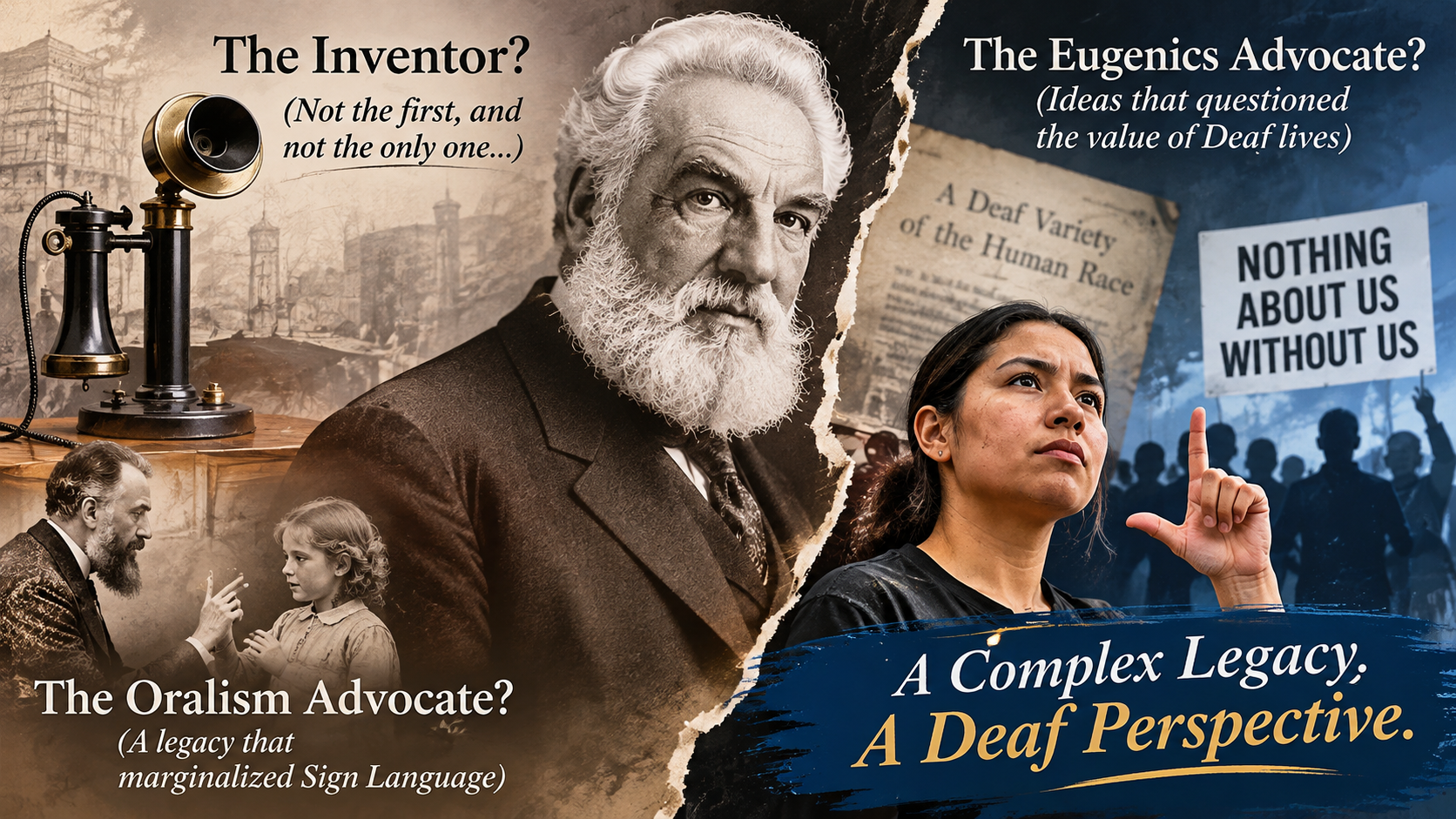
    Bell was one of the most influential advocates of oralism in Deaf education.

    He promoted speech-based education and opposed the use of sign language as the primary language of instruction for Deaf children. He also opposed Deaf people becoming teachers of Deaf children, believing they could not effectively teach speech and articulation.

    His influence contributed to an educational system that increasingly prioritized speech and lipreading while pushing sign language and Deaf educators to the margins.

    The consequences of that history lasted for generations.

    This wasn’t simply a disagreement over teaching methods.

    It was about language, identity, education, culture and power.

    It was about who had the authority to decide what Deaf children needed.

    And most importantly, Deaf people themselves were often not the ones making those decisions.

    The Dictionary of Canadian Biography documents how oral education expanded significantly while concerns from Deaf representatives who opposed exclusive oralism went unheard.

    From a Deaf community perspective, that history cannot simply be separated from Bell’s celebrated accomplishments.

    But even the telephone story is more complicated than we were taught

    There is another reason I think we should be willing to look more closely at Bell’s legacy.

    Many of us grew up with a very simple version of the story:

    Alexander Graham Bell invented the telephone.

    But the history of the telephone was much more complicated than that.

    Bell was certainly a major figure in its development. He obtained the famous U.S. Patent No. 174,465 in 1876 and went on to develop and commercialize a working telephone system. The Library of Congress notes that Bell is conventionally credited as the inventor because of his patent and successful development of a working device.

    However, Bell was not the first person to experiment with transmitting speech electrically.

    Italian inventor Antonio Meucci developed an early voice-communication device in the 1850s and filed a patent caveat in 1871. Due to financial difficulties, Meucci was unable to renew that caveat after 1874. Bell later obtained the telephone patent in 1876.

    The U.S. House of Representatives subsequently passed a resolution in 2002 recognizing Meucci’s life, achievements and contribution to the invention of the telephone.

    There were also other important contributors, including Johann Philipp Reis and Elisha Gray. The Library of Congress describes the history as a contentious invention story involving several people working toward similar breakthroughs.

    So even the familiar story of Bell as the singular inventor is more complicated than the version many of us learned.

    And I think that matters because it illustrates a broader point:

    Historical narratives often become much simpler than the history itself.

    A complicated story becomes a single name.

    A collection of contributors becomes one celebrated individual.

    And the experiences of people affected by that person’s work can disappear from the story altogether.

    That is exactly what I don’t want to happen with Deaf history.

    Then there is the eugenics connection

    This is the part that I think deserves considerably more public awareness.

    In 1884, Bell published Upon the Formation of a Deaf Variety of the Human Race.

    He expressed concern about Deaf people forming communities, socializing with one another and marrying other Deaf people.

    He feared that this could lead to what he described as a “deaf race.”

    Gallaudet University’s National Deaf Life Museum documents this history and explains how Bell’s ideas became influential within the oralist movement and intersected with eugenic thinking.

    Bell’s ideas about heredity and Deafness were not merely theoretical.

    They contributed to a broader social environment in which Deaf people were increasingly viewed through the lens of preventing or reducing Deafness.

    That should matter to us today.

    Because when society begins asking whether Deaf people should exist, whether Deaf children should be born, or whether Deafness should be prevented, we are no longer simply talking about history.

    We are talking about the value society places on Deaf lives.

    But history needs nuance

    As a Deaf advocate, I don’t think we strengthen this conversation by reducing Bell to a cartoon villain.

    The historical record is more complicated than that.

    Parks Canada’s revised designation acknowledges that Bell held eugenics-related beliefs and argued against intermarriage among congenitally Deaf people. But it also acknowledges that he opposed segregation, institutionalization, sterilization and legislative bans on intermarriage, and eventually abandoned formal involvement in eugenics organizations.

    Academic historians have similarly emphasized the complexity of Bell’s relationship with eugenics. Brian Greenwald and John Vickrey Van Cleve, for example, describe Bell as becoming entangled in the eugenic environment of his time while also attempting to prevent eugenicists from interfering with Deaf people’s reproductive rights.

    That distinction is important.

    We should not claim that Bell supported every coercive eugenic policy.

    But we also shouldn’t use those distinctions to erase his documented beliefs and influence.

    Both parts of the history deserve to be told.

    So why is this important now?

    Because Canada has actually done something significant.

    In 2025, the Historic Sites and Monuments Board of Canada reviewed Bell’s designation as a National Historic Person.

    Parks Canada subsequently revised the official reasons for his designation to acknowledge his oralist advocacy, discouragement of sign language and eugenics-related beliefs.

    That is not just a historical footnote.

    It is a change in how Canada officially remembers one of its most famous historical figures.

    And yet, I have to ask:

    How many Canadians know about it?

    And perhaps even more importantly:

    How many Deaf Canadians know about it?

    I’m not asking because I believe nobody in the Deaf community knows.

    Deaf historians, scholars, educators and community members have been discussing Bell’s legacy for decades.

    The issue is whether this particular development has reached the broader Deaf community and whether Deaf people have been meaningfully included in the process of determining how this history is represented.

    Those are two different things.

    Who gets to tell Deaf history?

    This is where I believe we need to go beyond simply asking whether Parks Canada got the history right.

    We should also ask:

    Who was involved in telling it?

    Parks Canada states that its designation review process can involve subject-matter experts, implicated communities, stakeholders and local communities.

    That’s important.

    But as a Deaf advocate, I want to know more.

    Were Deaf organizations consulted?

    Were Deaf historians and Deaf Studies scholars involved?

    Were Deaf community members given opportunities to contribute?

    What perspectives did they provide?

    How did those perspectives influence the final decision?

    And perhaps most importantly:

    How was the outcome communicated back to the Deaf community?

    Because there is a difference between having a consultation process and having meaningful Deaf participation.

    There is a difference between talking about Deaf people and creating space for Deaf people to shape the story.

    And there is a difference between making historical information technically accessible and making sure it actually reaches the community whose history is being discussed.

    This is about more than Alexander Graham Bell

    Bell is one person.

    But the larger issue is much bigger.

    For generations, Deaf people were told that speech was better than sign language.

    Deaf children were placed in educational systems designed around hearing norms.

    Deaf teachers were pushed aside.

    Sign languages were discouraged or prohibited.

    And decisions about Deaf people’s lives were frequently made without Deaf people having meaningful authority.

    This is part of our history.

    It is also part of the reason Deaf communities today continue to advocate for:

    Deaf-led education.

    Deaf leadership.

    Sign language rights.

    Deaf representation.

    Nothing about us without us.

    These aren’t simply modern slogans.

    They are responses to a very long history of decisions being made about Deaf people without Deaf people.

    And this is where Bell’s legacy becomes relevant today

    We might be tempted to say:

    “That was over a hundred years ago.”

    But some of the questions Bell’s legacy raises are still with us.

    Who decides what communication method a Deaf child should use?

    Who decides what constitutes a successful Deaf education?

    Who decides whether sign language is essential?

    Who decides whether Deaf people should be represented in decisions affecting Deaf children?

    And increasingly:

    Who gets to decide whether Deafness itself should exist?

    Today, we are having conversations about genetic testing, gene editing and technologies that could potentially prevent or alter Deafness.

    Those conversations are not identical to the eugenics debates of Bell’s era.

    But the historical connection is important.

    Whenever society discusses eliminating a characteristic from future generations, we need to ask:

    What are we saying about the people who already live with that characteristic?

    For Deaf people, Deafness isn’t simply a genetic condition to be corrected.

    It can be language.

    It can be culture.

    It can be community.

    It can be identity.

    It can be connection.

    It can be a way of experiencing the world.

    That perspective needs to be present in conversations about our future.

    Bell married a Deaf woman. Does that change the story?

    This is one argument that has emerged from Bell’s descendants.

    Bell’s wife, Mabel Hubbard Bell, was Deaf. Bell communicated with her and supported her in many ways.

    His descendants have also pointed to his statements supporting an individual’s freedom to marry whom they chose.

    Those facts are real and should not be ignored.

    But they don’t erase the larger historical record.

    A person can love and respect individual Deaf people while holding ideas that negatively affect Deaf people as a group.

    A person can have a Deaf spouse while advocating educational practices that marginalize Deaf language and Deaf teachers.

    A person can oppose government-enforced marriage restrictions while still warning Deaf people about marrying other Deaf people.

    Human beings are capable of holding contradictory beliefs.

    History doesn’t become clearer when we remove those contradictions.

    It becomes clearer when we examine them.

    What should Canada do with Bell’s legacy?

    I don’t believe the answer is to erase him.

    I don’t believe the answer is to remove every reference to him.

    And I don’t believe we should pretend his scientific and technological contributions didn’t happen.

    Instead, I believe Canada should tell the whole story.

    If visitors learn about Bell’s contributions to communication, they should also be able to learn about his influence on Deaf education.

    If his work in science is celebrated, his writings about hereditary Deafness should not be hidden.

    If his historic site tells his story, Deaf people’s experiences should be part of that interpretation.

    And if Canada is going to reconsider his historical designation, Deaf perspectives should be visible in that process.

    Not as an afterthought.

    Not as a footnote.

    Not simply as another stakeholder.

    As people whose history is directly connected to the story being told.

    We need more Deaf voices in the conversation

    This is perhaps the biggest reason I’m writing about this.

    Not because I think everyone needs to agree on Alexander Graham Bell.

    Not because I want to tell people what conclusion they should reach.

    And not because I think history should be rewritten to make us comfortable.

    I’m writing because Deaf history needs to be part of public history.

    For too long, Deaf history has existed in spaces that many people outside the Deaf community never encounter.

    Our stories are taught in Deaf schools, Deaf Studies programs, museums, archives, community organizations and within Deaf communities.

    But when national institutions tell Canadian history, those stories need to be there too.

    And when they are there, Deaf people need to be involved in telling them.

    That’s what Deaf leadership and representation should look like.

    So, did you know about this?

    If you already knew, I would love for you to continue the conversation.

    If you didn’t, I hope this gives you a reason to learn more.

    Read the historical research.

    Look at Bell’s own writings.

    Read the Parks Canada designation.

    Learn about the history of oralism.

    Learn about the Deaf people who challenged it.

    And, most importantly, listen to Deaf historians, Deaf scholars and Deaf community members who have been carrying this history for generations.

    Because this isn’t simply the story of Alexander Graham Bell.

    It’s part of our story.

    And when Canada decides how that story is remembered, Deaf people deserve a seat at the table.

    Not because we want to erase history.

    Not because we want to rewrite history.

    But because nothing about us should be remembered without us.

  • In Flanders Fields | An ASL Adaptation for Remembrance Day

    Here’s an ASL adaptation of In Flanders Fields by Lieutenant-Colonel John McCrae for Remembrance Day.

    May we remember those who served and sacrificed.

    Lest we forget. 🌺

  • Behind the Signs: Preparing to Perform O Canada in ASL and LSQ at the Heritage Classic

    Behind the Signs: Preparing to Perform O Canada in ASL and LSQ at the Heritage Classic

    Since the Heritage Classic, there’s been quite a bit of activity and conversation within the Deaf community surrounding my performance of O Canada in American Sign Language (ASL) and Langue des signes québécoise (LSQ).

    The video has garnered at least 30,000 views since I shared it, along with comments, shares and messages from people across the Deaf community.

    But there’s something many people may not know: the video I shared wasn’t actually the live broadcast of the performance. It was a recreation.

    During the Heritage Classic, I was introduced on the stadium screen at the beginning of the anthem. However, once the performance started, the camera shifted away from me and focused on SoulBear, the fans and the hockey players. As a result, the signing wasn’t visible for the majority of the performance.

    I subsequently received messages from Deaf Canadians expressing their disappointment that they couldn’t see the national anthem being performed in ASL and LSQ. For many, this was another reminder that accessibility isn’t just about having someone present. It’s also about making sure Deaf people can actually see and experience the performance.

    That’s why I decided to recreate the performance and share it publicly. I wanted the Deaf community to have the opportunity to experience what they had missed.

    There’s another aspect of this performance that makes it particularly meaningful. To my knowledge, this was the first documented performance of Canada’s national anthem bringing together all four languages: English, French, ASL and LSQ.

    Getting the representation right

    When I was initially informed that the national anthem would be performed in English and French, I was advised to translate the French lyrics into English first, then interpret the English version into ASL.

    However, I felt that approach would miss something important.

    Canada has two official spoken languages, English and French, but we also have distinct sign languages. ASL and LSQ are recognized under the Accessible Canada Act as primary languages for communication by Deaf people in Canada.

    In many contexts, ASL is associated with English-speaking Deaf communities, while LSQ is associated with French-speaking Deaf communities. They are distinct languages, each with its own linguistic and cultural identity.

    I wanted the performance to reflect that reality.

    The Heritage Classic featured the Winnipeg Jets and the Montreal Canadiens. It was a distinctly Canadian event, bringing together two teams and communities with their own linguistic and cultural connections. It would have felt incomplete to represent the anthem in English, French and ASL without also considering LSQ.

    I explained why having both sign languages was important. This meant going beyond simply translating words from one language into another. It was about recognizing Deaf Canadians and ensuring that both linguistic communities were represented.

    Learning, reaching out and taking on a challenge

    This is where the preparation became more involved.

    I started researching and reaching out to trusted members of the LSQ community, particularly professionals who were bilingual in ASL and LSQ. Ideally, I would have preferred to have someone who was genuinely fluent in both languages take on the performance alongside me.

    Unfortunately, there wasn’t anyone locally available at the time, and bringing someone in from outside the city wasn’t feasible.

    I decided to take on the responsibility myself.

    That meant receiving one-on-one LSQ coaching, practising the French portions of the anthem and making sure I was representing the language as accurately and respectfully as possible. I didn’t want to simply memorize signs and hope for the best. I wanted to understand what I was signing and ensure the LSQ portions were presented appropriately.

    It was a learning experience that required time, preparation and humility. I recognized that knowing ASL didn’t automatically mean I knew LSQ. They are different languages, and I needed guidance from people with the appropriate linguistic knowledge and experience.

    I’m grateful to those within the LSQ community who shared their expertise and helped me prepare.

    Catching the LSQ bug

    I’ve always been interested in learning LSQ, but I never really had a strong reason to use it regularly. Living in Winnipeg, my everyday interactions are primarily in ASL, and opportunities to use LSQ are relatively limited.

    This experience changed something for me.

    Through the preparation, coaching and exposure to LSQ, I developed an even greater appreciation for the language and its community. I found myself wanting to continue learning beyond what was needed for the performance.

    With English and French being Canada’s official languages, I also felt that developing a better understanding of LSQ was a meaningful way to deepen my connection to Canada’s linguistic landscape and Deaf communities.

    I may have started learning LSQ because of the Heritage Classic, but I don’t want it to end there. I’ve caught the LSQ bug, and I’m looking forward to continuing that learning journey.

    More than 30,000 views, but what matters most

    Since sharing the recreated performance, the video has continued to reach people well beyond my immediate network. The views, comments, shares and saves have been encouraging.

    I’ll admit, it feels good to know that something I worked so hard to prepare is making an impact, especially within the Deaf community across Canada.

    But the numbers aren’t really what make this meaningful.

    It’s the messages from Deaf Canadians who were excited to finally see the performance. It’s the appreciation for including LSQ alongside ASL. It’s the conversations about representation, accessibility and what it means to see our languages represented on a national stage.

    This experience reminded me that visibility matters. But visibility alone isn’t enough. Representation needs to be intentional, meaningful and grounded in the communities and languages being represented.

    I’m proud to have been part of this moment alongside SoulBear, who brought the anthem to life through English and French, while we worked together to bring ASL and LSQ into the performance.

    And perhaps one of the biggest takeaways for me is that this experience has opened another door. What started as an opportunity to perform Canada’s national anthem became an opportunity to learn, collaborate and develop a deeper appreciation for another sign language community in Canada.

    Four languages. One national anthem. And a reminder that Deaf Canadians belong in the moments where our country comes together.

    That’s something worth continuing to build on.

  • Why Winnipeg Roars “TRUE NORTH!” (And Why I’ll Sign It That Way Tomorrow)

    Why Winnipeg Roars “TRUE NORTH!” (And Why I’ll Sign It That Way Tomorrow)

    Here’s the story of how Winnipeg lost its Jets… and how a quiet, stubborn group of locals brought them home.

    It starts with a sound you’ll only ever hear in one building on the Prairies.

    The lights are low. Fifteen thousand people are on their feet. The anthem singer reaches the line that every Canadian knows by heart—the True North strong and free—and the entire arena erupts as one:

    “TRUE NORTH!”

    It’s not in the official lyrics. It never was. Yet it feels more Winnipeg than almost anything else in the song. That shout is pure gratitude, pure pride, and a little bit of unfinished business. To understand why it hits so hard, you have to go back to the night the city went quiet.

    In the spring of 1996, the Winnipeg Jets played their last game at the old Winnipeg Arena. The building was aging. The team was losing money. Ownership couldn’t find a way to stay. On a warm July day the franchise was sold to American interests and shipped south to become the Phoenix Coyotes. Just like that, the Jets were gone.

    For a lot of people here, it felt personal. Hockey wasn’t just entertainment. It was the winter heartbeat of the city. Kids had grown up dreaming of wearing that crest. Parents had spent paycheques on season tickets. When the moving trucks left, something in the civic spirit left with them. Downtown felt emptier. Winters felt longer. People still talk about where they were when they heard the news, the way people remember where they were during a blackout.

    What followed were the lean years. No NHL. No big nights. Just the ache of what used to be. Some cities might have let the dream die. Winnipeg didn’t. A small group of local business people, led by Mark Chipman, refused to accept that the story was over. In 1996—while the wounds were still fresh—they brought the Minnesota Moose north and rebranded them the Manitoba Moose. It wasn’t the NHL, but it kept the ice cold and the seats full. It kept the habit of gathering under one roof for hockey alive.

    Then they did something even more important. They built a real arena.

    The MTS Centre (now Canada Life Centre) rose in the middle of downtown in 2004. It wasn’t flashy by big-city standards, but it was modern, intimate, and owned by people who actually lived here. True North Sports & Entertainment was never just a company name. It was a statement: we’re staying. We’re investing. We’re not waiting for someone else to save us.

    For years they watched. They studied the economics of the new NHL. They talked quietly with the league. Twice they came painfully close to bringing the original Jets franchise home from Phoenix. Once, Chipman later said, they were “within ten minutes” of sealing the deal before Glendale found more money to keep the team. The near-misses hurt, but they also proved something: Winnipeg was ready. The arena was ready. The ownership group was ready. All they needed was the right moment.

    That moment arrived in the spring of 2011.

    The Atlanta Thrashers were struggling. True North moved. On the morning of May 31, Mark Chipman stood in front of the media at the MTS Centre and said the words the city had waited fifteen years to hear. The NHL was coming back. The team would be called the Jets again.

    Tickets went on sale a few days later. Thirteen thousand season tickets sold in seventeen minutes. Grown men cried in the ticket lines. Strangers hugged. For the first time in a generation, Winnipeg felt whole again.

    A few months later, during one of the very first home games, something spontaneous happened. When the anthem reached “the True North strong and free,” a few voices in the crowd shouted the company name that had made the miracle possible. The next night a few more joined in. Then the whole building. No one organized it. No one asked for it. It just happened—the purest kind of thank-you a city can give.

    That’s why, every single time the national anthem plays at a Jets game, the same roar rises. It’s not marketing. It’s memory. It’s the sound of a city that lost something precious, refused to stay broken, and quietly, stubbornly, brought it home.

    So the next time you hear fifteen thousand people shout “TRUE NORTH!” in the middle of “O Canada,” know what you’re really hearing.

    You’re hearing the long winter that followed 1996.
    You’re hearing the people who kept showing up for the Moose.
    You’re hearing the risk of building an arena when no team was guaranteed.
    You’re hearing the almost-deals that fell through and the one that finally didn’t.
    And you’re hearing a city that still remembers what it felt like to lose its team—and refuses to take having it back for granted.

    That’s the story. And every time the chant hits, Winnipeg tells it again.

  • Building a Hybrid Interpreting Strategy for Government and Crown Services: On-Demand + Scheduled + In-Person

    Building a Hybrid Interpreting Strategy for Government and Crown Services: On-Demand + Scheduled + In-Person

    Government and Crown services interact with the public in many different ways — scheduled appointments, formal meetings, walk-in counters, urgent inquiries, and everything in between. No single interpreting method covers all of these situations effectively.

    A practical hybrid strategy combines three complementary approaches: on-demand video remote interpreting (VRI), scheduled interpreting, and in-person interpreting. Used together, they create consistent access without forcing every interaction into one model.

    The Three Components

    Scheduled interpreting is arranged in advance for known dates, times, and durations. It works well for formal meetings, hearings, training sessions, and planned appointments. Advance booking allows for preparation, subject-matter briefing, and logistical coordination.

    In-person interpreting places a qualified interpreter physically present at the location. It is often preferred for longer, complex, or high-stakes interactions, sensitive discussions, or settings where visual and environmental context matter significantly.

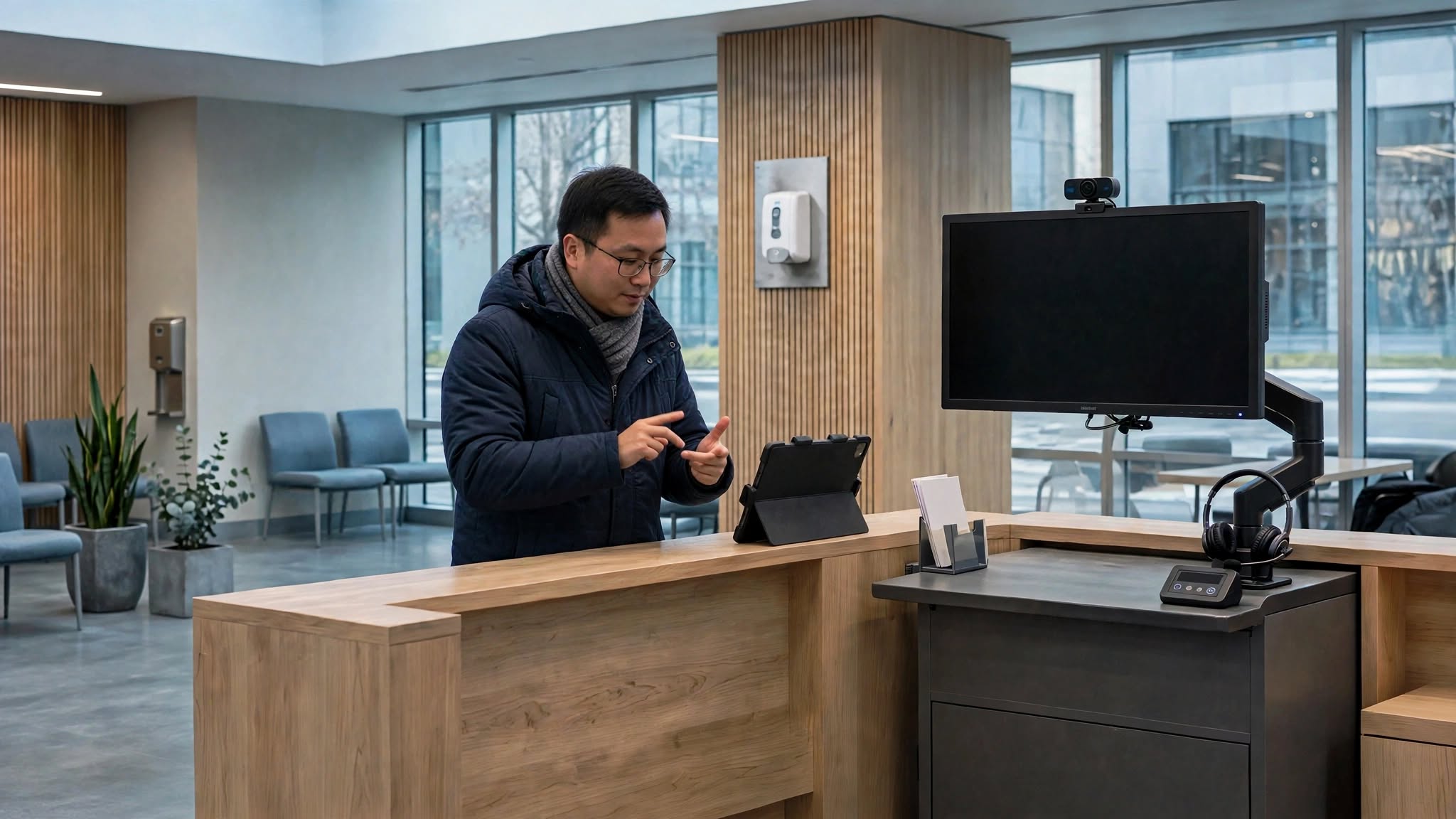
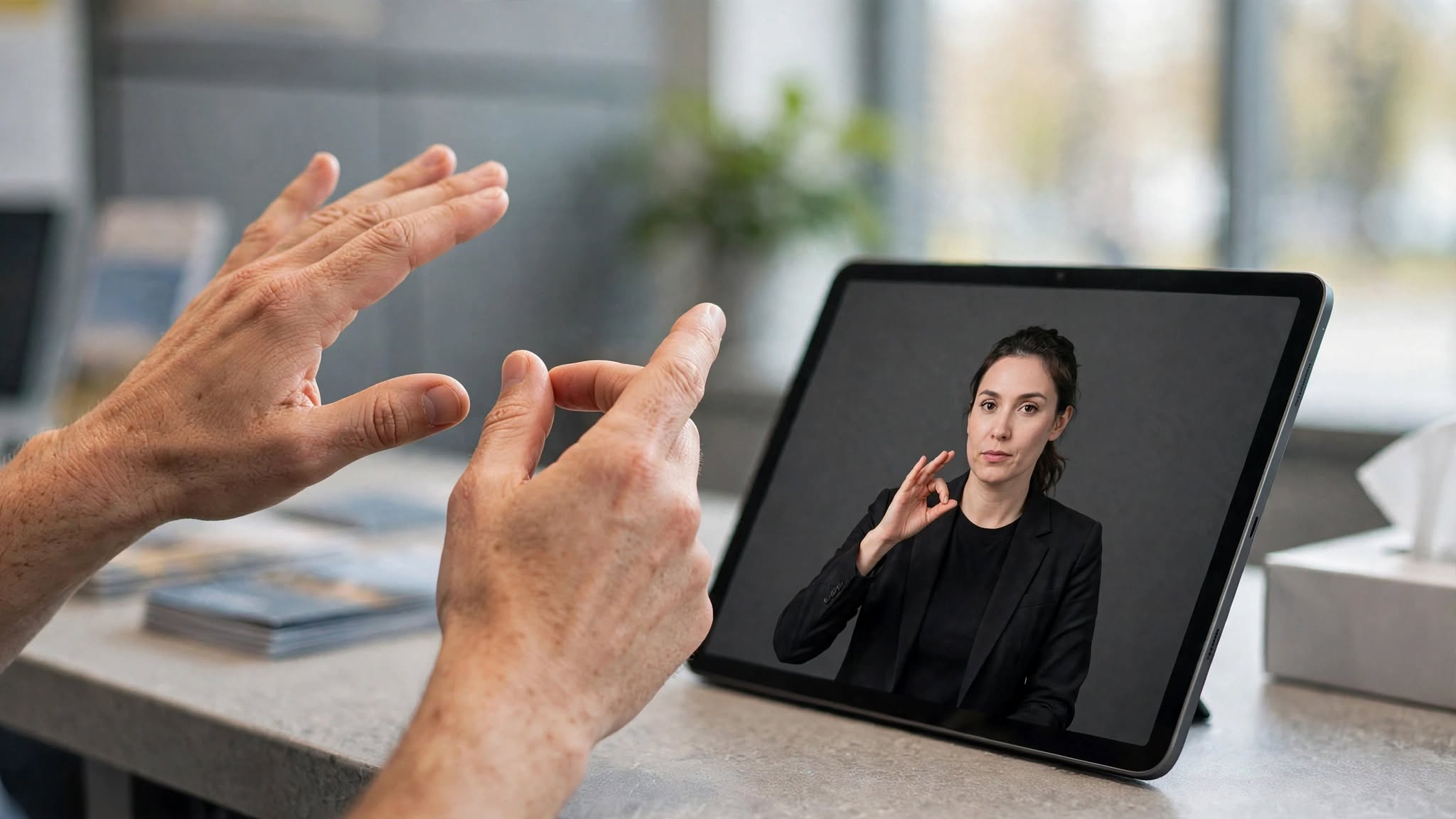
    On-demand VRI provides immediate access when no interpreter has been booked. Staff connect through a platform and are matched with a qualified ASL or LSQ interpreter within seconds from a laptop, tablet, or mobile device. It is designed for unplanned or urgent needs that cannot wait for scheduling.

    Each method solves a different operational problem. Treating them as interchangeable creates gaps. Treating them as complementary closes those gaps.

    Matching the Method to the Situation

    A clear hybrid model assigns each approach to the situations it handles best:

    • Use scheduled interpreting when the need is known in advance and preparation adds value.
    • Use in-person interpreting for complex, lengthy, or high-stakes interactions where physical presence is important.
    • Use on-demand VRI for walk-ins, urgent inquiries, last-minute needs, and any situation where waiting or rescheduling is not acceptable.

    This structure gives front-line teams clear guidance and reduces the risk of defaulting to incomplete workarounds when an unexpected need arises.

    Why a Hybrid Approach Works for Government and Crown Services

    Public-sector environments regularly produce both planned and unplanned communication needs. Relying only on scheduled or in-person interpreting leaves the “right now” moments uncovered. Relying only on on-demand VRI may miss the benefits of preparation and physical presence for more complex interactions.

    A hybrid strategy delivers:

    • Coverage for both anticipated and unexpected needs
    • Greater consistency across locations, shifts, and service channels
    • Reduced pressure on staff who previously had limited options
    • Stronger alignment between accessibility commitments and daily operations

    On-demand VRI does not replace scheduled or in-person services. It fills the critical space between them.

    Implementing the Strategy

    Successful hybrid models usually include three practical elements:

    1. Clear internal guidance so staff know which option to use and how to access it.
    2. Reliable on-demand capability that meets professional standards for ASL and LSQ interpreting.
    3. Continued investment in scheduled and in-person services for the situations that require them.

    When these pieces are in place, accessibility becomes more consistent and less dependent on whether someone remembered to book ahead.

    A Practical Next Step

    Review a recent period of service interactions and identify how often communication needs arose without advance notice. Those instances point directly to where on-demand VRI strengthens the overall model.

    A hybrid strategy is not theoretical. It is a working combination of planned support, physical presence when needed, and immediate access when timing cannot wait.

    Visit asign.ca to explore how on-demand ASL and LSQ interpreting can complement your existing scheduled and in-person services, or reach out to discuss a hybrid approach tailored to your government or Crown operations.

    Three methods. One goal: reliable access in every situation that matters.

  • How to Choose an On-Demand VRI Platform That Meets Public-Sector Requirements (Security, Quality, Speed)

    How to Choose an On-Demand VRI Platform That Meets Public-Sector Requirements (Security, Quality, Speed)

    Provincial, municipal, federal, and Crown organizations evaluating on-demand video remote interpreting (VRI) face a clear set of operational requirements. The platform must deliver professional ASL and LSQ interpreting quickly, maintain high quality, and meet the security expectations of public-sector environments.

    Choosing well means looking beyond marketing claims and focusing on three core dimensions: security, quality, and speed.

    1. Security: Protecting Sensitive Information

    Public-sector interactions frequently involve personal, financial, health, or regulated information. A suitable VRI platform should support:

    • Interpreters who can hold appropriate security clearances (Reliability through Top Secret where required)
    • Secure connection protocols and data handling practices aligned with government expectations
    • Clear policies on confidentiality and professional ethics

    Ask providers to explain how they manage security requirements and whether their interpreter pool includes individuals cleared for the levels your organization needs.

    2. Quality: Professional Standards and Language Coverage

    Speed without quality creates new risks. Quality in Canadian VRI rests on two foundations: qualified interpreters and reliable coverage of both ASL and LSQ.

    Key indicators include:

    • Interpreters who meet recognized professional standards and belong to established associations
    • CASLI (Canadian Association of Sign Language Interpreters) — the national body for ASL-English interpreters, managing the Canadian Evaluation System (CES) and Certificate of Interpretation (COI)
    • AQILS (Association québécoise des interprètes en langues des signes) — the professional association representing sign language interpreters (including LSQ and ASL) in Quebec, focused on ethics, certification standards, and professional development
    • WAVLI (Westcoast Association of Visual Language Interpreters) — the provincial association for ASL-English interpreters in British Columbia, which holds legislative title protection for Registered ASL-English Interpreter and related titles

    A strong platform draws on interpreters affiliated with these (or equivalent) bodies and provides consistent, high-quality service in both ASL and LSQ across regions.

    3. Speed: Access Measured in Seconds, Not Minutes

    The defining value of on-demand VRI is immediate availability. Evaluate:

    • Average time from request to live interpreter
    • Performance during peak periods
    • Ease of launching a session from standard devices (laptop, tablet, or mobile) with minimal training

    If staff cannot connect quickly under real service-counter or office conditions, the platform will see limited use precisely when it is needed most.

    Putting the Three Requirements Together

    A platform that excels in only one or two areas leaves gaps. Public-sector teams need all three working together:

    • Security that meets organizational and regulatory expectations
    • Quality grounded in professional standards, association affiliation, and full ASL/LSQ coverage
    • Speed that delivers an interpreter in seconds rather than creating new delays

    When these elements are present, on-demand VRI becomes a reliable complement to scheduled interpreting — closing the gap for unplanned interactions without compromising standards.

    A Practical Evaluation Approach

    Before deciding, request clear answers on connection times, interpreter qualifications and affiliations (CASLI, AQILS, WAVLI or equivalent), available security clearances, and how the platform performs in typical public-facing environments. Where possible, observe a live demonstration under conditions that resemble your actual service settings.

    The right choice supports both accessibility commitments and day-to-day operational reality.

    Visit asign.ca to explore how on-demand ASL and LSQ interpreting can meet public-sector requirements for security, quality, and speed, or reach out to discuss the criteria that matter most for your organization.

    Security. Quality. Speed. All three are non-negotiable for public-sector access that works.

  • 5 Questions Every Provincial, Municipal & Crown Accessibility Lead Should Ask Before Choosing VRI

    5 Questions Every Provincial, Municipal & Crown Accessibility Lead Should Ask Before Choosing VRI

    Choosing a video remote interpreting (VRI) solution is a practical decision with lasting operational impact. For provincial, municipal, and Crown accessibility leads, the goal is not simply to add a new tool — it is to close the gap between planned interpreting and the unplanned moments that define much of public service delivery.

    Before selecting a platform, these five questions help separate solutions that look good on paper from those that perform reliably in real public-sector environments.

    1. How quickly can staff actually connect to an interpreter?

    Speed is the core value of on-demand VRI. Ask for clear information on average connection times and what happens during peak periods. A platform that requires multiple steps, long waits, or complex logins undermines the purpose of on-demand access.

    The practical test is simple: if a Deaf client is standing at a service counter right now, how long until a qualified ASL or LSQ interpreter is available on screen?

    2. Are both ASL and LSQ supported at a professional level?

    Canada’s linguistic reality includes both American Sign Language (ASL) and Langue des signes québécoise (LSQ). A solution that treats one language as secondary creates uneven access across regions and client groups.

    Confirm that the platform provides reliable, high-quality interpreting in both ASL and LSQ, delivered by qualified professionals.

    3. What professional standards and affiliations do the interpreters meet?

    Public-sector environments often involve sensitive information, regulated processes, and security requirements. Ask about interpreter qualifications, ongoing professional development, security clearances (including Reliability through Top Secret where relevant), and professional association membership.

    In Canada, several key organizations set professional expectations:

    • CASLI (Canadian Association of Sign Language Interpreters, formerly AVLIC) is the national professional association and certifying body for ASL-English interpreters. It manages the Canadian Evaluation System (CES) and grants the Certificate of Interpretation (COI). CASLI also maintains a public Interpreter Directory of vetted professionals.
    • AQILS (Association québécoise des interprètes en langues des signes) is the professional non-profit association representing sign language interpreters (including LSQ and ASL) in Quebec. Interpreters join AQILS to adhere to professional codes of ethics, maintain certification standards, and access networking and continuous professional development. LSQ interpreters in Quebec are primarily represented and supported by AQILS.
    • WAVLI (Westcoast Association of Visual Language Interpreters) is the provincial professional association for ASL-English interpreters in British Columbia. WAVLI supports members and advances sign language interpretation standards through professional development and leadership. It holds legislative occupational title protection in B.C., meaning only members in good standing may use the restricted titles: Registered ASL-English Interpreter, Registered Sign Language Interpreter, and Registered Visual Language Interpreter.

    CASLI and AQILS maintain an organizational partnership to support consistent professional standards across the country. Asking whether interpreters are affiliated with these associations (or equivalent recognized provincial bodies such as WAVLI) helps ensure the people who appear on screen meet established ethical and professional expectations.

    4. How easily can front-line staff use the platform in real conditions?

    The best technology fails if it is difficult to access under pressure. Consider:

    • Can staff launch a session from a laptop, tablet, or mobile device with minimal training?
    • Is the process consistent across locations and shifts?
    • Does it work in typical service-counter or office environments?

    A solution that requires specialized equipment or lengthy setup will see limited adoption precisely when it is needed most.

    5. Does the provider understand Canadian public-sector realities?

    On-demand VRI for government, provincial, municipal, and Crown services is not the same as a generic consumer video tool. Look for experience with Canadian accessibility expectations, bilingual (ASL/LSQ) delivery, and the operational patterns of public-facing teams.

    A provider that understands these contexts can support both the technology and the practical rollout across your organization.

    Moving from Evaluation to Decision

    These questions help accessibility leads move beyond feature lists and focus on operational fit. The right VRI solution should make professional ASL and LSQ interpreting available within seconds, integrate smoothly into existing workflows, and complement — rather than replace — scheduled interpreting services.

    When the answers are clear and positive, on-demand access becomes a reliable part of the service model instead of another item on a future wish list.

    Visit asign.ca to explore how on-demand ASL and LSQ interpreting can support your provincial, municipal, or Crown operations, or reach out to discuss the questions that matter most for your team.

    The right questions lead to the right capability — available when it is needed.

  • Inclusive Communication Beyond the Checklist: What Real Access Looks Like for Public-Sector Organizations This September

    Inclusive Communication Beyond the Checklist: What Real Access Looks Like for Public-Sector Organizations This September

    September often brings renewed attention to accessibility. International Day of Sign Languages, the International Week of Deaf People, and National Day for Truth and Reconciliation all highlight the importance of inclusion and the removal of barriers.

    For public-sector organizations, these moments frequently prompt review of policies, training, and existing supports. Checklists are updated. Commitments are restated. Scheduled interpreting arrangements are confirmed.

    Checklists are useful. They are not the same as real access.

    What a Checklist Cannot Cover

    Many federal, provincial, municipal, and Crown organizations have solid foundations in place: accessibility policies, staff awareness, and scheduled interpreting for planned meetings and events.

    What a checklist rarely captures is the unplanned moment — the walk-in at a service counter, the urgent inquiry, the intake process that begins without notice. In these situations, the absence of an immediately available interpreter turns good intentions into delay.

    Clients wait. Staff improvise. Interactions are postponed or left incomplete. The gap between documented commitment and lived experience becomes clear.

    What Real Access Looks Like

    Real access means a Deaf or hard-of-hearing person can communicate in ASL or LSQ at the moment they need to — without waiting for an appointment, without relying on informal workarounds, and without being asked to return another day.

    On-demand video remote interpreting (VRI) makes this possible.

    With a platform such as Asign On, staff can connect to a qualified ASL or LSQ interpreter within seconds from a laptop, tablet, or mobile device. No advance booking is required. Communication begins face to face, in real time, in the language the person uses.

    This capability does not replace scheduled interpreting. It completes the picture. Planned support covers known needs. On-demand access covers the moments that cannot be anticipated — the moments that define much of day-to-day public service.

    Moving Beyond Compliance This September

    September provides a natural point for public-sector teams to assess whether their current approach delivers consistent access or only planned access.

    A practical test is straightforward:

    If a Deaf client needed an ASL or LSQ interpreter right now in one of your service channels, how quickly could your team provide one?

    If the answer involves waiting, rescheduling, or incomplete alternatives, the opportunity to strengthen access is immediate.

    Inclusive communication is not only about meeting requirements. It is about ensuring that when someone needs to communicate, the system is ready.

    A Clear Step Forward

    Policies and checklists create the framework. Operational capability delivers the result.

    Adding on-demand ASL and LSQ interpreting alongside existing scheduled services gives provincial, municipal, federal, and Crown teams a practical way to close the remaining gap. Access becomes consistent rather than conditional on whether someone remembered to book ahead.

    Visit asign.ca to explore how on-demand interpreting can support your public-sector operations, or reach out to discuss a practical next step for your team.

    Checklists document the intention. Real access is measured in the moment communication is needed.

  • Accessibility and Reconciliation: Ensuring Communication Access Across Government, Provincial, Municipal & Crown Services

    Accessibility and Reconciliation: Ensuring Communication Access Across Government, Provincial, Municipal & Crown Services

    National Day for Truth and Reconciliation invites reflection on history, responsibility, and the ongoing work of building more respectful and inclusive public institutions.

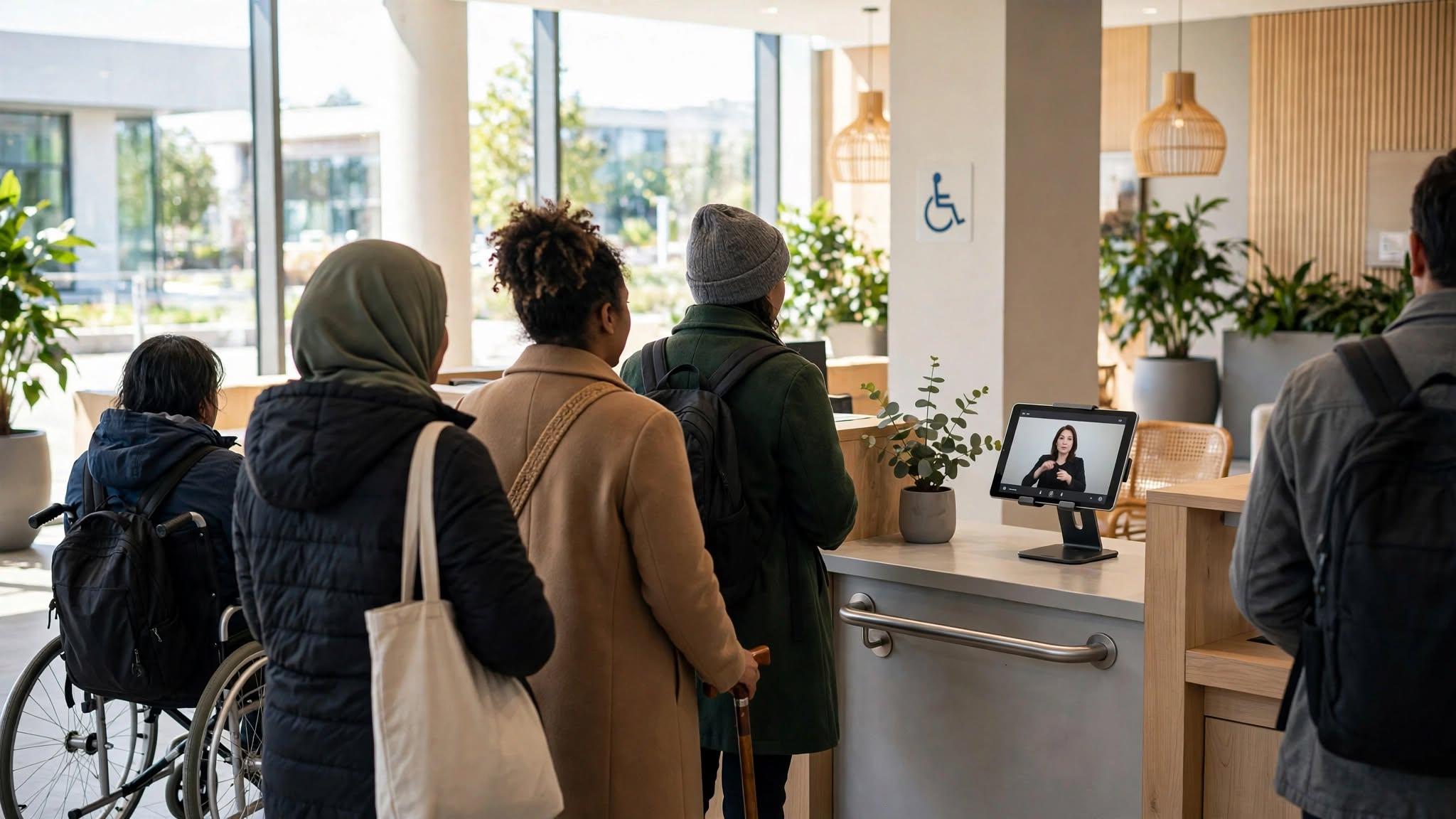
    Part of that work includes ensuring that government, provincial, municipal, and Crown services are genuinely accessible to everyone who needs them — including Deaf, hard-of-hearing, and DeafBlind people who use ASL or LSQ.

    Communication access is not separate from inclusion. It is one of the practical ways public services demonstrate respect and remove barriers.

    Access That Depends on Timing Is Incomplete

    Many public-sector organizations have made clear commitments to accessibility. Policies exist. Scheduled interpreting is arranged for planned meetings and events. Training and awareness efforts continue.

    Yet unplanned interactions remain common across service counters, intake processes, and client channels. When a Deaf or hard-of-hearing person needs to communicate and no interpreter is immediately available, access becomes conditional. Waiting, rescheduling, written notes, or informal assistance often follow.

    In those moments, the gap between commitment and delivery is visible. Equitable service requires more than good intentions — it requires the ability to respond in real time.

    Making Communication Access Immediate

    On-demand video remote interpreting (VRI) provides a practical way to close that gap.

    With a platform such as Asign On, staff across federal, provincial, municipal, and Crown channels can connect to a qualified ASL or LSQ interpreter within seconds from a laptop, tablet, or mobile device. No advance booking is required. Communication begins face to face, in the language the person uses.

    This capability does not replace scheduled interpreting. It complements it. Planned support covers known needs. On-demand access covers the moments that cannot be anticipated — the moments that define much of day-to-day public service.

    Why This Matters for Inclusive Public Services

    When ASL and LSQ interpreting is available instantly:

    • Citizens and clients can access services without unnecessary delay or workarounds
    • Front-line staff have a clear, reliable option instead of improvising
    • Service delivery remains more consistent across locations and shifts
    • Accessibility commitments move from policy into everyday operations

    Removing communication barriers is one concrete expression of respect. It supports the broader goal of public services that work equitably for the people they are meant to serve.

    A Practical Step Forward

    Reflection is important. Action makes the difference.

    One clear question helps assess current readiness:

    If a Deaf or hard-of-hearing person needed an ASL or LSQ interpreter right now in one of your service channels, how quickly could your team provide one?

    If the answer involves waiting or incomplete alternatives, the opportunity to strengthen access is immediate.

    Ensuring communication access across government, provincial, municipal, and Crown services is practical, achievable, and aligned with the ongoing work of building more inclusive institutions.

    Visit asign.ca to explore how on-demand interpreting can support your service channels, or reach out to discuss a practical next step for your team.

    Respect is shown in many ways. One of them is making sure people can communicate when they need to.

  • Sign Language Rights Are Human Rights — How Federal, Provincial & Crown Services Can Deliver Them in Seconds

    Sign Language Rights Are Human Rights — How Federal, Provincial & Crown Services Can Deliver Them in Seconds

    Sign language rights are human rights.

    This principle sits at the centre of the International Day of Sign Languages and the broader recognition of Deaf people’s right to communicate in their own languages — ASL and LSQ in the Canadian context.

    Recognition is essential. Legislation, policies, and public statements matter.

    What matters most in daily public service is whether those rights can be exercised in real time.

    Rights Without Immediate Access Remain Incomplete

    Federal, provincial, and Crown services interact with citizens and clients every day through counters, intake processes, inquiries, and support channels. Many of these interactions cannot be scheduled in advance.

    When a Deaf or hard-of-hearing person needs to communicate and no interpreter is immediately available, the right to accessible communication becomes conditional on timing. Waiting, rescheduling, written notes, or informal assistance often follow.

    In those moments, the gap between principle and practice becomes visible.

    Delivering Rights in Seconds

    On-demand video remote interpreting (VRI) turns the principle into operational reality.

    With a platform such as Asign On, staff in federal, provincial, and Crown settings can connect to a qualified ASL or LSQ interpreter within seconds from a laptop, tablet, or mobile device. No advance booking is required. Communication begins face to face, in real time, in the language the person uses.

    This capability does not replace scheduled interpreting for planned meetings and appointments. It fills the critical space between planned support and immediate need — the space where many public service interactions actually occur.

    What Changes When Access Is Instant

    When on-demand ASL and LSQ interpreting is available across service channels:

    • Citizens and clients can exercise their communication rights without delay
    • Front-line staff have a clear, reliable option instead of improvising
    • Service delivery remains consistent across locations and shifts
    • Accessibility commitments move from policy documents into everyday operations

    The result is practical respect for human rights. Access is no longer deferred. It is delivered in the moment it is required.

    A Practical Test for Public-Sector Teams

    One question helps separate recognition from delivery:

    If a Deaf person needed an ASL or LSQ interpreter right now in one of your service channels, how quickly could your team provide one?

    If the answer involves waiting or workarounds, the right exists on paper but is not yet fully available in practice.

    Sign language rights are human rights. Delivering them in seconds is how federal, provincial, and Crown services turn that statement into lived experience.

    Visit asign.ca to explore how on-demand interpreting can support your service channels, or reach out to discuss a practical next step for your team.

    Rights recognized. Access delivered — in seconds.